Research
September 22, 2026
Economic outlook
U.S. economy poised to remain resilient despite consumer pressures
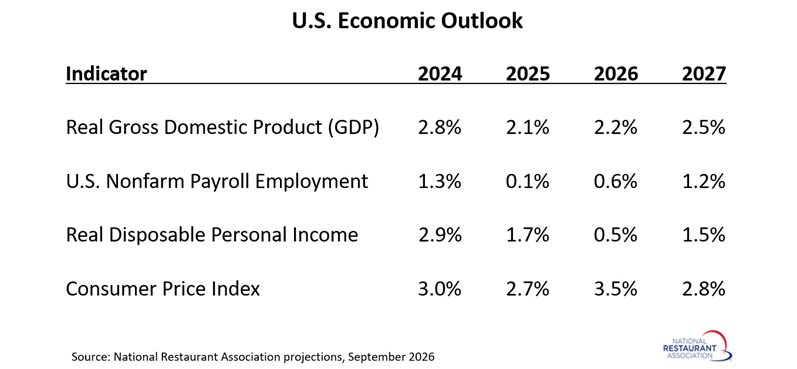
Restaurant operators continue to navigate a complex mix of economic forces affecting sales, traffic, and profitability. Encouragingly, the broader U.S. economy has remained resilient, with the National Restaurant Association forecasting real GDP growth of 2.2% in 2026. Consumer spending has continued to benefit from solid wage gains and healthy household incomes, particularly among higher-income households, which remain a key driver of economic activity. Business investment has also supported growth, especially in emerging technologies such as artificial intelligence, helping offset some of the uncertainty facing consumers and businesses alike.
At the same time, several headwinds continue to challenge the operating environment. Inflation pressures have reemerged, leaving many consumers increasingly value-conscious and selective in how they spend their hard-earned dollars. Elevated gasoline prices, tighter household budgets, and growing financial strain among many families have added to affordability concerns. Labor market conditions also remain a source of uncertainty. While recent job growth has been stronger than expected, hiring has generally slowed compared with recent years, and labor force participation remains near five-year lows, leaving too many potential workers on the sidelines. These dynamics not only complicate staffing efforts for restaurant operators but also constrain overall economic growth and consumer spending.
Against this backdrop, the Association's third-quarter Consumer Insights survey highlights an increasingly "K-shaped" consumer environment. While 65% of adults rated their financial well-being positively, nearly four in ten said their financial situation had worsened over the past year, with younger and lower-income consumers facing the greatest pressures. Even so, restaurants remain a top discretionary spending priority, with more than half of consumers dining out in the previous week and half ordering takeout or delivery.
However, affordability concerns are beginning to weigh on behavior, as nearly four in ten consumers reported spending less at restaurants than in the prior quarter and increasingly relying on discounts, trading down to lower-priced options, and reducing add-on purchases.
For restaurant operators, this mixed economic environment creates both opportunities and challenges. Continued economic growth, rising household incomes, and consumers' enduring preference for restaurant occasions provide reasons for cautious optimism. Yet elevated operating costs, ongoing labor constraints, uncertain demand patterns, and widespread affordability concerns suggest that growth is likely to remain uneven. Many operators remain hesitant to pass through higher costs amid soft traffic trends, even as labor, food, and other expenses continue to rise. As a result, success in the year ahead will depend on carefully balancing value, hospitality, innovation, and operational efficiency. The restaurant industry has repeatedly demonstrated its resilience, but navigating the current environment will require adaptability, discipline, and a clear understanding of an increasingly divided consumer landscape.
This article presents the latest trends in key economic indicators as well as an outlook for the year ahead. Visit this page throughout the year for the Association’s latest projections for the U.S. economy.
Job growth has slowed in 2026 but remains encouraging
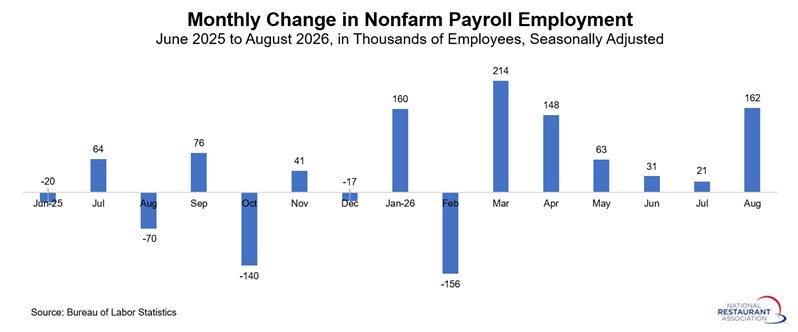
Nonfarm payroll employment increased by 162,000 in August, more than triple the consensus forecast of roughly 50,000. Moreover, payroll gains for June and July were revised higher by a combined 55,000. Through the first eight months of 2026, the U.S. economy has added 643,000 nonfarm jobs, with employment increasing in seven of those eight months. This stronger-than-expected performance is encouraging amid persistent economic uncertainty and underscores the underlying resilience of the U.S. economy.
Continued growth in employment and wages remains essential to supporting household spending, the primary driver of economic activity. Even so, labor market conditions remain softer than in recent years. Job growth has slowed and become more volatile in 2026, while labor force participation continued to be near a five-year low.
Unemployment rate remains historically low
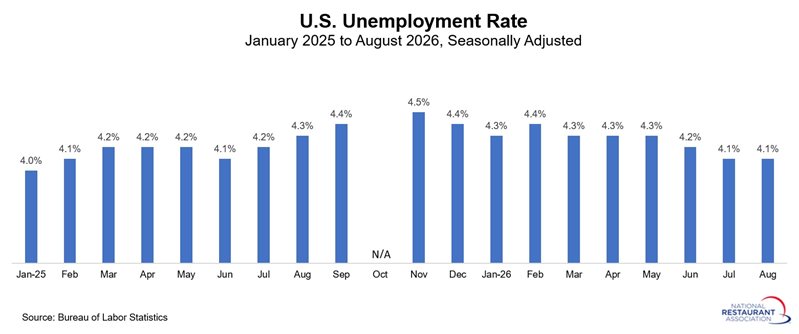
The unemployment rate held steady at 4.1% in August for the second consecutive month, remaining at its lowest level since June 2025. Despite concerns about labor force participation, the relatively low unemployment rate suggests that labor market conditions remain healthy by historical standards.
The civilian labor force showed some improvement in August, increasing from 169.09 million in July to 169.78 million. However, it remains down by 2.40 million since the start of 2026. As a result, the labor force participation rate edged up from 61.4% in July, its lowest level since February 2021, to 61.6% in August.
Even with the August gain, the broader trend points to a shrinking pool of available workers. Many potential workers remain on the sidelines, continuing to constrain labor supply and likely creating ongoing recruiting and retention challenges for employers, including restaurant operators.
Economy projected to add 900,000 jobs in 2026
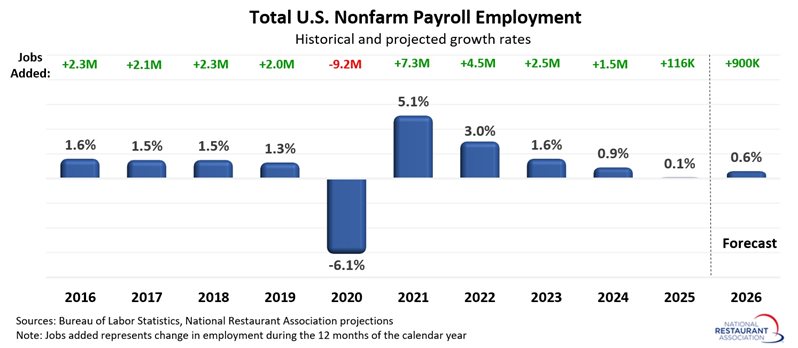
Job growth slowed materially in 2025, adding only 116,000 nonfarm payroll workers, the weakest annual job growth since 2020. Yet, even with significant tailwinds in the economy and notable downside risks, the labor market is seen generating a net 900,000 jobs in 2026. Despite more sluggish job growth in 2025 and 2026, it should represent the sixth consecutive year of nonfarm payroll employment growth, adding nearly 5 million jobs since the end of 2022.
Real personal income growth expected to slow
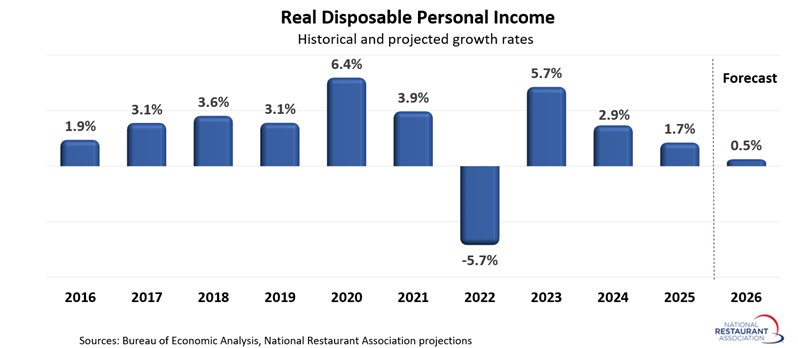
Wage growth is expected to remain solid in 2026, reflecting a labor market that, while softer than in recent years, continues to be relatively tight. However, inflation is likely to erode much of those income gains. Real disposable personal income, a key driver of restaurant sales, is projected to increase just 0.5% in 2026, down from 1.6% in 2025 and 2.9% in 2024. While households should continue to see income growth, their purchasing power is expected to advance at a much slower pace.
Inflation has trended higher this year
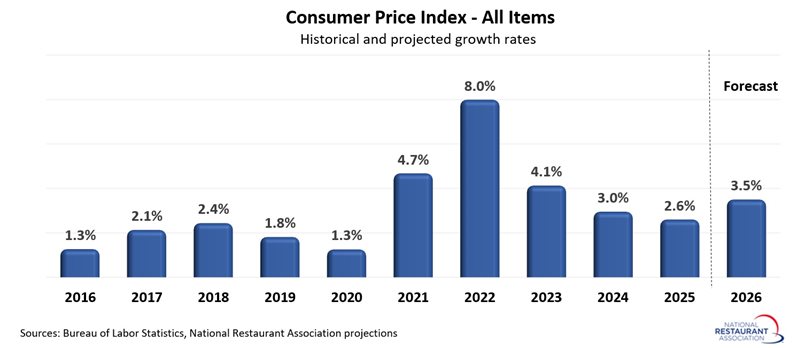
Higher energy costs have contributed to a pickup in inflation this year, with the conflict with Iran pushing petroleum prices significantly higher. This resurgence in price pressures follows several years of moderating inflation after the consumer price index peaked at 8.0% in 2022, the fastest annual increase in four decades. Inflation's recent acceleration has moved it further from the Federal Reserve's 2% target, prompting the Federal Open Market Committee to raise short-term interest rates at its September 15-16 meeting as it seeks to restore price stability. Further hikes are also expected.
If tensions ease and the Strait of Hormuz reopens, energy markets could stabilize, helping to moderate broader inflationary pressures. However, any relief is unlikely to be immediate. As a result, the National Restaurant Association now forecasts consumer price inflation of 3.5% in 2026, up from 2.6% in 2025.
Economic growth remains surprisingly resilient
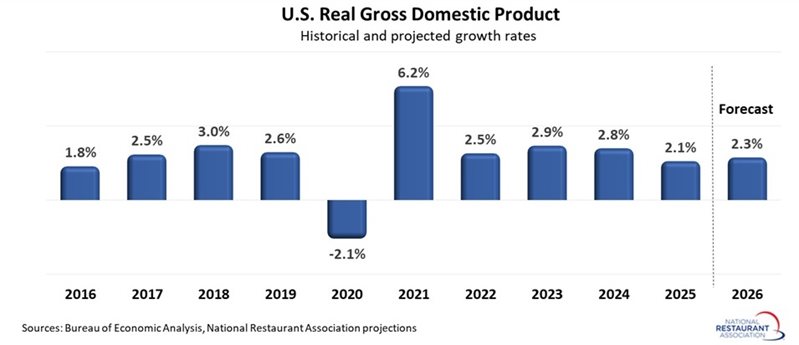
Overall, the U.S. economy has remained surprisingly resilient despite numerous headwinds. Real Gross Domestic Product (GDP) should rise by 2.2% at the annual rate in 2026, up from 2.1% in 2025. Even so, uncertainty and affordability challenges are likely to persist, with geopolitical risks, including the ongoing conflict involving Iran, continuing to pose potential headwinds to the outlook.
At the same time, several headwinds continue to challenge the operating environment. Inflation pressures have reemerged, leaving many consumers increasingly value-conscious and selective in how they spend their hard-earned dollars. Elevated gasoline prices, tighter household budgets, and growing financial strain among many families have added to affordability concerns. Labor market conditions also remain a source of uncertainty. While recent job growth has been stronger than expected, hiring has generally slowed compared with recent years, and labor force participation remains near five-year lows, leaving too many potential workers on the sidelines. These dynamics not only complicate staffing efforts for restaurant operators but also constrain overall economic growth and consumer spending.
Against this backdrop, the Association's third-quarter Consumer Insights survey highlights an increasingly "K-shaped" consumer environment. While 65% of adults rated their financial well-being positively, nearly four in ten said their financial situation had worsened over the past year, with younger and lower-income consumers facing the greatest pressures. Even so, restaurants remain a top discretionary spending priority, with more than half of consumers dining out in the previous week and half ordering takeout or delivery.
However, affordability concerns are beginning to weigh on behavior, as nearly four in ten consumers reported spending less at restaurants than in the prior quarter and increasingly relying on discounts, trading down to lower-priced options, and reducing add-on purchases.
For restaurant operators, this mixed economic environment creates both opportunities and challenges. Continued economic growth, rising household incomes, and consumers' enduring preference for restaurant occasions provide reasons for cautious optimism. Yet elevated operating costs, ongoing labor constraints, uncertain demand patterns, and widespread affordability concerns suggest that growth is likely to remain uneven. Many operators remain hesitant to pass through higher costs amid soft traffic trends, even as labor, food, and other expenses continue to rise. As a result, success in the year ahead will depend on carefully balancing value, hospitality, innovation, and operational efficiency. The restaurant industry has repeatedly demonstrated its resilience, but navigating the current environment will require adaptability, discipline, and a clear understanding of an increasingly divided consumer landscape.
This article presents the latest trends in key economic indicators as well as an outlook for the year ahead. Visit this page throughout the year for the Association’s latest projections for the U.S. economy.
Job growth has slowed in 2026 but remains encouraging
Nonfarm payroll employment increased by 162,000 in August, more than triple the consensus forecast of roughly 50,000. Moreover, payroll gains for June and July were revised higher by a combined 55,000. Through the first eight months of 2026, the U.S. economy has added 643,000 nonfarm jobs, with employment increasing in seven of those eight months. This stronger-than-expected performance is encouraging amid persistent economic uncertainty and underscores the underlying resilience of the U.S. economy.
Continued growth in employment and wages remains essential to supporting household spending, the primary driver of economic activity. Even so, labor market conditions remain softer than in recent years. Job growth has slowed and become more volatile in 2026, while labor force participation continued to be near a five-year low.
Unemployment rate remains historically low
The unemployment rate held steady at 4.1% in August for the second consecutive month, remaining at its lowest level since June 2025. Despite concerns about labor force participation, the relatively low unemployment rate suggests that labor market conditions remain healthy by historical standards.
The civilian labor force showed some improvement in August, increasing from 169.09 million in July to 169.78 million. However, it remains down by 2.40 million since the start of 2026. As a result, the labor force participation rate edged up from 61.4% in July, its lowest level since February 2021, to 61.6% in August.
Even with the August gain, the broader trend points to a shrinking pool of available workers. Many potential workers remain on the sidelines, continuing to constrain labor supply and likely creating ongoing recruiting and retention challenges for employers, including restaurant operators.
Economy projected to add 900,000 jobs in 2026
Job growth slowed materially in 2025, adding only 116,000 nonfarm payroll workers, the weakest annual job growth since 2020. Yet, even with significant tailwinds in the economy and notable downside risks, the labor market is seen generating a net 900,000 jobs in 2026. Despite more sluggish job growth in 2025 and 2026, it should represent the sixth consecutive year of nonfarm payroll employment growth, adding nearly 5 million jobs since the end of 2022.
Real personal income growth expected to slow
Wage growth is expected to remain solid in 2026, reflecting a labor market that, while softer than in recent years, continues to be relatively tight. However, inflation is likely to erode much of those income gains. Real disposable personal income, a key driver of restaurant sales, is projected to increase just 0.5% in 2026, down from 1.6% in 2025 and 2.9% in 2024. While households should continue to see income growth, their purchasing power is expected to advance at a much slower pace.
Inflation has trended higher this year
Higher energy costs have contributed to a pickup in inflation this year, with the conflict with Iran pushing petroleum prices significantly higher. This resurgence in price pressures follows several years of moderating inflation after the consumer price index peaked at 8.0% in 2022, the fastest annual increase in four decades. Inflation's recent acceleration has moved it further from the Federal Reserve's 2% target, prompting the Federal Open Market Committee to raise short-term interest rates at its September 15-16 meeting as it seeks to restore price stability. Further hikes are also expected.
If tensions ease and the Strait of Hormuz reopens, energy markets could stabilize, helping to moderate broader inflationary pressures. However, any relief is unlikely to be immediate. As a result, the National Restaurant Association now forecasts consumer price inflation of 3.5% in 2026, up from 2.6% in 2025.
Economic growth remains surprisingly resilient
Overall, the U.S. economy has remained surprisingly resilient despite numerous headwinds. Real Gross Domestic Product (GDP) should rise by 2.2% at the annual rate in 2026, up from 2.1% in 2025. Even so, uncertainty and affordability challenges are likely to persist, with geopolitical risks, including the ongoing conflict involving Iran, continuing to pose potential headwinds to the outlook.