Research
August 19, 2026
Consumer outlook
Consumer outlook remains cautiously optimistic
The outlook for consumers clouded somewhat in recent months, as the performance of some key indicators softened. Most notably was the U.S. labor market, which deteriorated in recent months after an encouraging start to the year.
A healthy and expanding labor market is a key driver of restaurant sales, as it gives households the financial wherewithal boost spending. High rates of employment also increase consumers’ need for the convenience that the industry provides on a daily basis.
Another renewed challenge was an uptick in gas prices, which continue to garner an outsized share of consumers’ budget relative to a few months ago. After trending gradually lower throughout much of June, pump prices reversed course in July and once again breached the $4 threshold. The national average for a gallon of regular gasoline has now been near or above $4 for more than four months, which puts strain on household budgets.
At the same time, household balance sheets on the aggregate remain relatively healthy. Although debt levels continue to rise, they remain manageable when compared to disposable income. Household wealth also continues to trend higher, which supports the spending of consumers with homes and investments.
Despite the added headwinds, consumers remained resilient and continued to prioritize restaurants in their spending decisions. Eating and drinking place sales rose for the fourth consecutive month in July – a period during which monthly volume jumped by more than $3 billion.
While the latest data point to a mixed environment for consumers, the outlook remains cautiously optimistic. As long as the labor market doesn’t deteriorate further, it is likely that consumers on the aggregate will maintain their ability to continue spending in the months ahead.
This article presents the latest trends in key indicators that impact consumer activity. Visit this page throughout the year for ongoing analysis of the state of the American consumer.
Labor market cooled in recent months
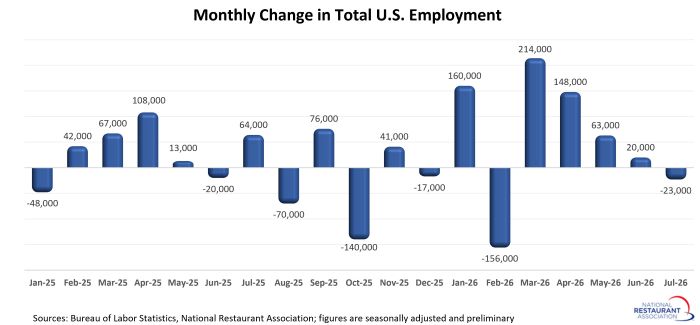
Following a promising start to the year, the U.S. labor market deteriorated in recent months. After peaking with an increase of 214,000 jobs in March – the largest monthly gain since December 2024 – job growth slowed in each of the next four months. That included a net loss of 23,000 jobs in July. Even with the recent slowdown, the economy added more than 425,000 jobs during the first seven months of 2026. That was significantly better than the modest gain of 116,000 jobs during the entirety of 2025.
Consumer confidence remains dampened
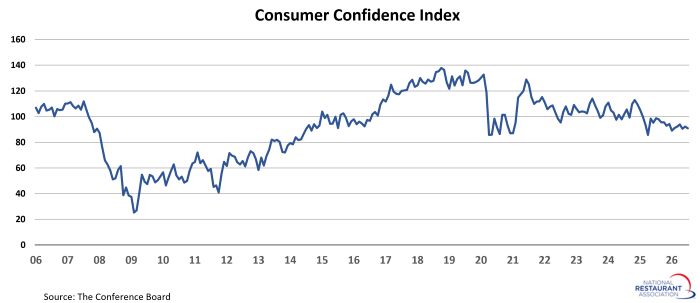
Along with the softer labor market, The Conference Board’s Consumer Confidence Index remains dampened. This measure of consumer sentiment started trending lower in early 2025 and has yet to bounce back in a sustained way. The downward trend was largely due to declines in the expectations component of the index, which measures consumers’ short-term outlook for income, business, and labor market conditions.
Wage growth slowed in recent months
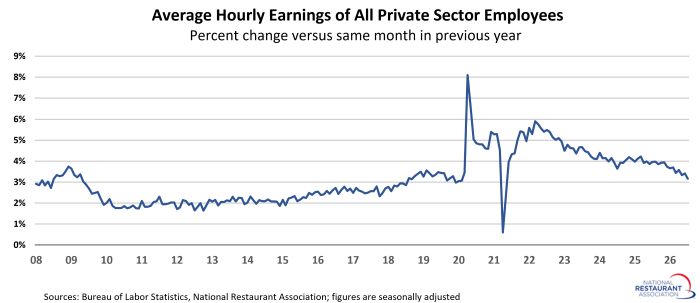
On top of the weaker job growth in recent months, wage growth decelerated as well. Average hourly earnings of private sector employees rose just 3.2% between July 2025 and July 2026. That was nearly 4 percentage points below the strong gains posted during 2022 and represented the smallest 12-month gain since 2021. The 12-month increase of 3.2% was also slightly below the 3.3% average increase during 2019.
Savings rate declined in recent months
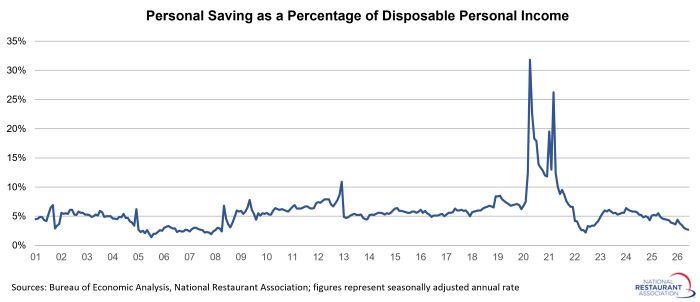
Along with decelerating wage gains, the uptick in inflation means consumers are seeing little to no income growth in inflation-adjusted terms. To support continued spending, many households are tapping into their savings to support their expenditures. That led to the personal savings rate falling to 2.7% in June, which was the lowest level since mid-2022. It was also well below the pre-pandemic savings rate, which averaged 6.5% between 2017 and 2019.
Household wealth surged in recent quarters
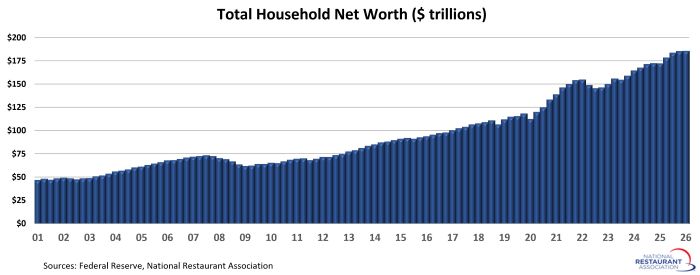
Household wealth continues to trend higher, reaching a new record high of $183 trillion in the first quarter of 2026. Total household net worth increased in 9 of the last 10 quarters, a period during which wealth jumped by nearly $31 trillion. During the last 4 quarters alone, household net worth surged more than $13 trillion. That positively impacts consumers’ willingness to spend on discretionary items, including restaurants.
Household debt leveled off
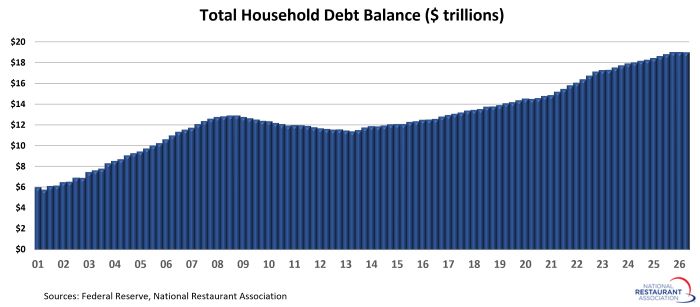
After trending steadily higher in recent years, household debt levels plateaued in recent quarters. Aggregate household debt balances totaled $18.8 trillion in the second quarter of 2026. That was essentially unchanged from the previous two quarters. Mortgages represent the bulk of household debt at 70%, followed by auto loans (9%), student loans (9%) and credit cards (7%).
Debt to income ratio remains manageable
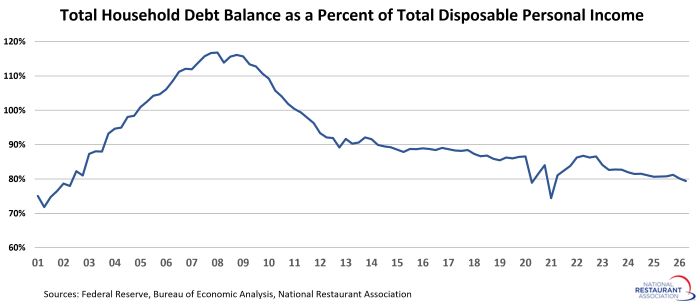
Even though debt levels are elevated, it remains manageable in relation to income. In the second quarter of 2026, the total household debt balance was 79% of total disposable personal income. Aside from two quarters during the pandemic, that’s the lowest debt-to-income ratio in 24 years. It’s also well below the record highs of more than 116% registered during the Great Recession in 2007 and 2008.
Revolving credit balances continue to rise
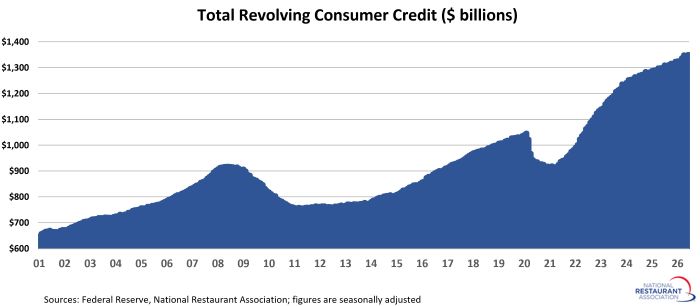
Revolving consumer credit rose sharply during the last 5 years, following an early-pandemic period during which balances dropped by more than 12%. By June 2026, total revolving credit balances topped $1.3 trillion, which was $305 billion (or 29%) above their pre-pandemic peak.
Debt service remains in check
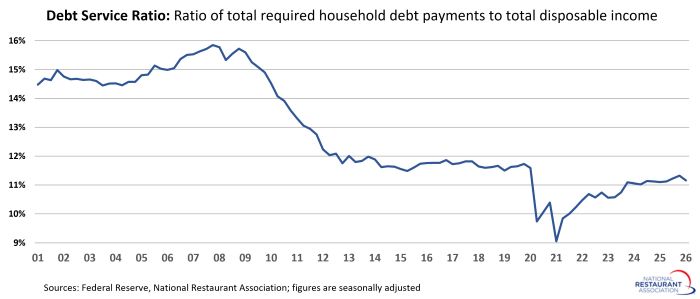
Despite the elevated debt levels, debt service remains manageable for households on the aggregate. The Federal Reserve’s Debt Service Ratio, which is the ratio of total required household debt payments to total disposable income, was just over 11% in the first quarter of 2026. While that was higher than the lows posted during the first half of 2021, it remained slightly below pre-pandemic readings.
Overall delinquency rates edged lower
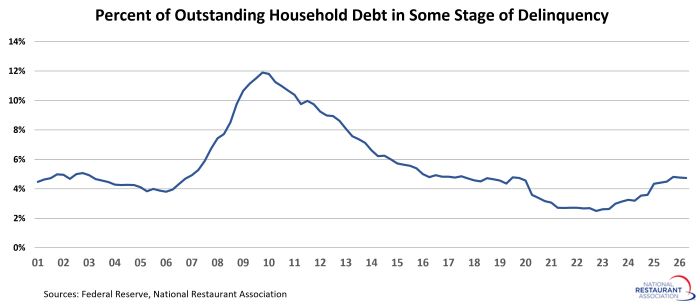
Along with manageable debt service levels in historical terms, overall delinquency rates ticked lower in recent quarters. As of 2026:Q2, 4.7% of outstanding household debt was in some stage of delinquency. That marked the second consecutive quarterly decline, which followed six straight quarters of rising delinquency rates. Despite the recent dip, the overall delinquency rate was up more than 2 full percentage points from the recent low of 2.5% in 2022:Q4, and remained near the highest level since 2017:Q3 (4.9%).
Credit card delinquencies remain elevated
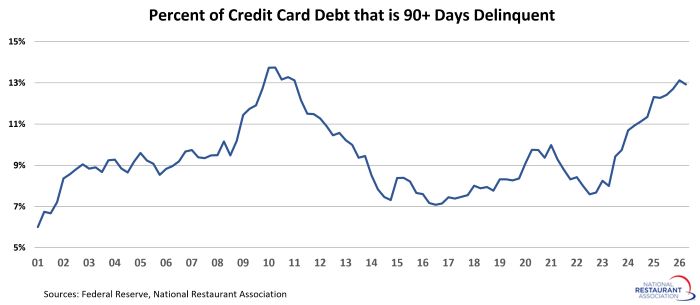
While it ticked lower in the second quarter of 2026, the percentage of credit cards that were severely delinquent rose sharply in recent quarters. As of 2026:Q2, 12.9% of credit card debt was at least 90 days delinquent. That was up from a recent low of 7.6% in 2022:Q3 and remained near the highest level in 15 years.
Student loan delinquencies are approaching pre-pandemic highs
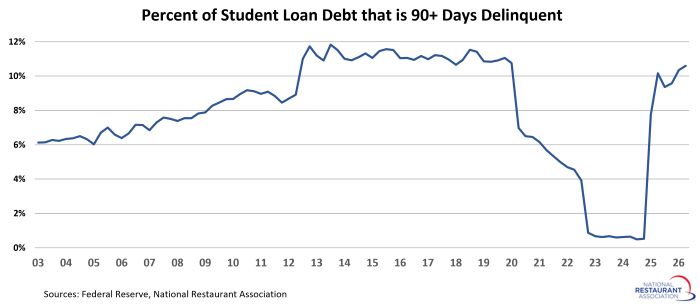
The number of severely delinquent student loans continues to trend higher, following the resumption of reporting missed federal student loan payments to credit bureaus after the nearly 5-year pause due to the pandemic. As of 2026:Q2, 10.6% of student loan debt was at least 90 days delinquent. That was up from 10.3% in 2026:Q1 and represented the highest level since 2020:Q1 (10.8%).
A healthy and expanding labor market is a key driver of restaurant sales, as it gives households the financial wherewithal boost spending. High rates of employment also increase consumers’ need for the convenience that the industry provides on a daily basis.
Another renewed challenge was an uptick in gas prices, which continue to garner an outsized share of consumers’ budget relative to a few months ago. After trending gradually lower throughout much of June, pump prices reversed course in July and once again breached the $4 threshold. The national average for a gallon of regular gasoline has now been near or above $4 for more than four months, which puts strain on household budgets.
At the same time, household balance sheets on the aggregate remain relatively healthy. Although debt levels continue to rise, they remain manageable when compared to disposable income. Household wealth also continues to trend higher, which supports the spending of consumers with homes and investments.
Despite the added headwinds, consumers remained resilient and continued to prioritize restaurants in their spending decisions. Eating and drinking place sales rose for the fourth consecutive month in July – a period during which monthly volume jumped by more than $3 billion.
While the latest data point to a mixed environment for consumers, the outlook remains cautiously optimistic. As long as the labor market doesn’t deteriorate further, it is likely that consumers on the aggregate will maintain their ability to continue spending in the months ahead.
This article presents the latest trends in key indicators that impact consumer activity. Visit this page throughout the year for ongoing analysis of the state of the American consumer.
Labor market cooled in recent months
Following a promising start to the year, the U.S. labor market deteriorated in recent months. After peaking with an increase of 214,000 jobs in March – the largest monthly gain since December 2024 – job growth slowed in each of the next four months. That included a net loss of 23,000 jobs in July. Even with the recent slowdown, the economy added more than 425,000 jobs during the first seven months of 2026. That was significantly better than the modest gain of 116,000 jobs during the entirety of 2025.
Consumer confidence remains dampened
Along with the softer labor market, The Conference Board’s Consumer Confidence Index remains dampened. This measure of consumer sentiment started trending lower in early 2025 and has yet to bounce back in a sustained way. The downward trend was largely due to declines in the expectations component of the index, which measures consumers’ short-term outlook for income, business, and labor market conditions.
Wage growth slowed in recent months
On top of the weaker job growth in recent months, wage growth decelerated as well. Average hourly earnings of private sector employees rose just 3.2% between July 2025 and July 2026. That was nearly 4 percentage points below the strong gains posted during 2022 and represented the smallest 12-month gain since 2021. The 12-month increase of 3.2% was also slightly below the 3.3% average increase during 2019.
Savings rate declined in recent months
Along with decelerating wage gains, the uptick in inflation means consumers are seeing little to no income growth in inflation-adjusted terms. To support continued spending, many households are tapping into their savings to support their expenditures. That led to the personal savings rate falling to 2.7% in June, which was the lowest level since mid-2022. It was also well below the pre-pandemic savings rate, which averaged 6.5% between 2017 and 2019.
Household wealth surged in recent quarters
Household wealth continues to trend higher, reaching a new record high of $183 trillion in the first quarter of 2026. Total household net worth increased in 9 of the last 10 quarters, a period during which wealth jumped by nearly $31 trillion. During the last 4 quarters alone, household net worth surged more than $13 trillion. That positively impacts consumers’ willingness to spend on discretionary items, including restaurants.
Household debt leveled off
After trending steadily higher in recent years, household debt levels plateaued in recent quarters. Aggregate household debt balances totaled $18.8 trillion in the second quarter of 2026. That was essentially unchanged from the previous two quarters. Mortgages represent the bulk of household debt at 70%, followed by auto loans (9%), student loans (9%) and credit cards (7%).
Debt to income ratio remains manageable
Even though debt levels are elevated, it remains manageable in relation to income. In the second quarter of 2026, the total household debt balance was 79% of total disposable personal income. Aside from two quarters during the pandemic, that’s the lowest debt-to-income ratio in 24 years. It’s also well below the record highs of more than 116% registered during the Great Recession in 2007 and 2008.
Revolving credit balances continue to rise
Revolving consumer credit rose sharply during the last 5 years, following an early-pandemic period during which balances dropped by more than 12%. By June 2026, total revolving credit balances topped $1.3 trillion, which was $305 billion (or 29%) above their pre-pandemic peak.
Debt service remains in check
Despite the elevated debt levels, debt service remains manageable for households on the aggregate. The Federal Reserve’s Debt Service Ratio, which is the ratio of total required household debt payments to total disposable income, was just over 11% in the first quarter of 2026. While that was higher than the lows posted during the first half of 2021, it remained slightly below pre-pandemic readings.
Overall delinquency rates edged lower
Along with manageable debt service levels in historical terms, overall delinquency rates ticked lower in recent quarters. As of 2026:Q2, 4.7% of outstanding household debt was in some stage of delinquency. That marked the second consecutive quarterly decline, which followed six straight quarters of rising delinquency rates. Despite the recent dip, the overall delinquency rate was up more than 2 full percentage points from the recent low of 2.5% in 2022:Q4, and remained near the highest level since 2017:Q3 (4.9%).
Credit card delinquencies remain elevated
While it ticked lower in the second quarter of 2026, the percentage of credit cards that were severely delinquent rose sharply in recent quarters. As of 2026:Q2, 12.9% of credit card debt was at least 90 days delinquent. That was up from a recent low of 7.6% in 2022:Q3 and remained near the highest level in 15 years.
Student loan delinquencies are approaching pre-pandemic highs
The number of severely delinquent student loans continues to trend higher, following the resumption of reporting missed federal student loan payments to credit bureaus after the nearly 5-year pause due to the pandemic. As of 2026:Q2, 10.6% of student loan debt was at least 90 days delinquent. That was up from 10.3% in 2026:Q1 and represented the highest level since 2020:Q1 (10.8%).