Research
September 11, 2026
Menu Prices
Consumer prices, including at restaurants, rose solidly in August, fueled by higher gas prices
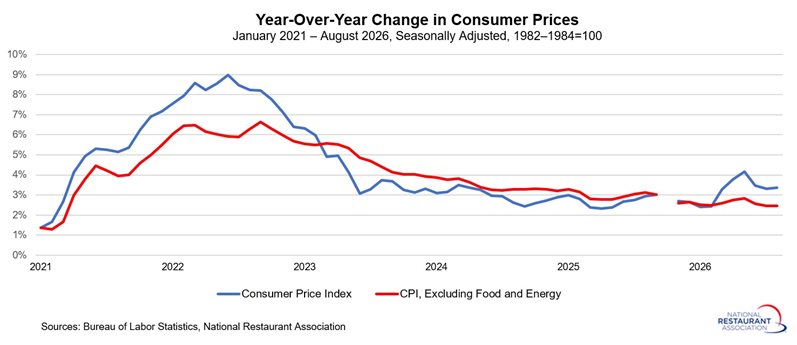
Consumer prices rose 0.4% in August, accelerating from a 0.1% gain in July and marking the strongest monthly increase since May. Gasoline prices increased 3.9%, rebounding after declines in June and July and standing 27.4% higher than a year ago. Meanwhile, food prices edged up 0.1% for the second consecutive month. Restaurant menu prices also continued to rise at a solid pace, increasing 0.3% in both July and August. As a result, headline inflation accelerated from 3.4% year-over-year in July to 3.5% in August.
Core CPI, which excludes food and energy, increased 0.3% in August, up from 0.2% in July and the largest monthly gain since April. Despite the monthly pickup, core inflation eased on a 12-month basis, slowing from 2.5% in July to 2.4% in August, the lowest annual rate since February 2021. August price increases were led by transportation services (+0.5%), used cars and trucks (+0.4%), new vehicles (+0.3%), and shelter (+0.3%). In contrast, prices for medical care commodities and medical care services both declined 0.2%.
The August acceleration in inflation was largely anticipated, particularly given higher energy costs. With oil prices continuing to climb amid ongoing tensions in the Middle East and restricted flows through the Strait of Hormuz, inflationary pressures are likely to remain elevated in September.
As a result, the Federal Open Market Committee is expected to raise short-term interest rates at its September 15-16 meeting. Although the broader economy has remained resilient, inflation continues to run above the Federal Reserve's target, requiring policymakers to remain vigilant in their efforts to restore price stability. Additional rate increases could follow in coming meetings if inflation fails to show more meaningful progress toward the Fed's goal.
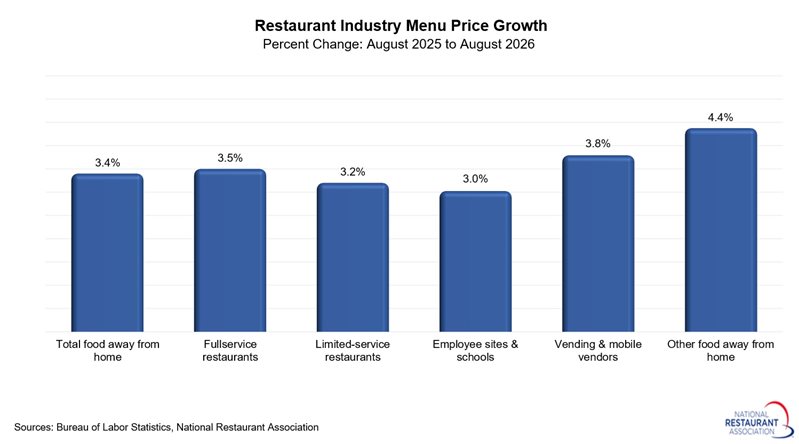
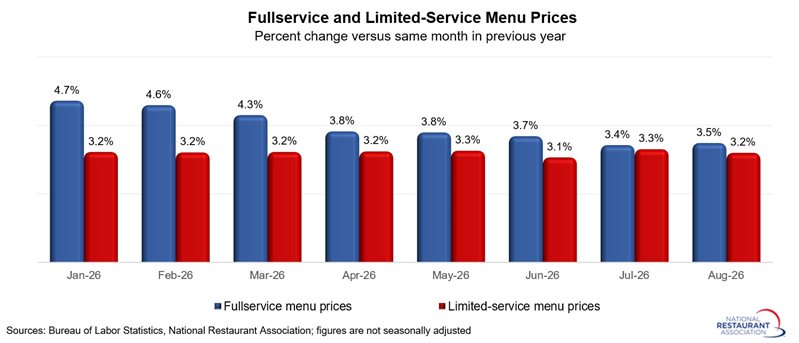
In the food away from home category, menu prices at fullservice restaurants rose 0.4% in August, up from 0.2% in August. So far this year, fullservice restaurant menu prices have also averaged 0.4% growth per month, a solid pace. Meanwhile, menu prices at limited-service restaurants were flat in August, slowing from 0.4% growth in July, with average monthly growth of 0.2% year to date. On a year-on-year basis, fullservice restaurant menu prices grew 3.5% since August 2025, with 3.2% growth year-on-year for limited-service businesses.
Within the broader food-away-from-home category, prices for food from vending machines and mobile vendors jumped 1.2% in August, up from 0.3% in July and the strongest pace in 11 months. At the same time, food prices at employee sites and schools rose 0.6% in August, continuing to rise at a solid pace for the third straight month. Food prices at other food away from home locations increased 0.9% in August.
Year-over-year, prices at vending and mobile vendors rose 3.8% since August 2025, with prices at employee sites and schools up 3.0% year-over-year. The broader “other food away from home” category posted a 4.4% annual increase in prices in August over the past 12 months.
Core CPI, which excludes food and energy, increased 0.3% in August, up from 0.2% in July and the largest monthly gain since April. Despite the monthly pickup, core inflation eased on a 12-month basis, slowing from 2.5% in July to 2.4% in August, the lowest annual rate since February 2021. August price increases were led by transportation services (+0.5%), used cars and trucks (+0.4%), new vehicles (+0.3%), and shelter (+0.3%). In contrast, prices for medical care commodities and medical care services both declined 0.2%.
The August acceleration in inflation was largely anticipated, particularly given higher energy costs. With oil prices continuing to climb amid ongoing tensions in the Middle East and restricted flows through the Strait of Hormuz, inflationary pressures are likely to remain elevated in September.
As a result, the Federal Open Market Committee is expected to raise short-term interest rates at its September 15-16 meeting. Although the broader economy has remained resilient, inflation continues to run above the Federal Reserve's target, requiring policymakers to remain vigilant in their efforts to restore price stability. Additional rate increases could follow in coming meetings if inflation fails to show more meaningful progress toward the Fed's goal.
Menu prices continued to increase solidly
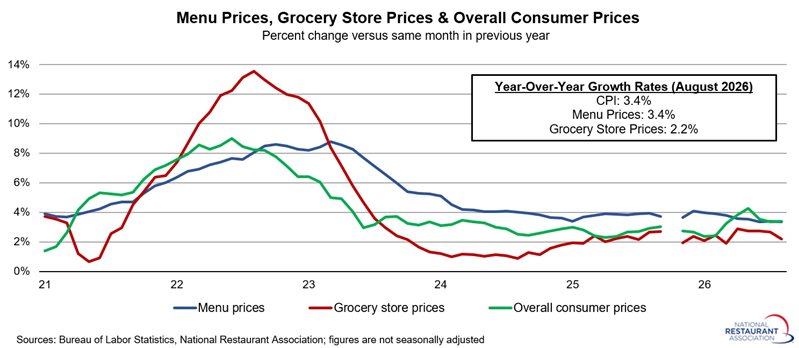
Menu prices increased 0.3% in both July and August, which was also the average monthly rate year to date. On a year-over-year basis, menu prices were 3.4% higher than in August 2025, the same annual pace as in the prior two months and continuing to be the slowest since January 2025. While restaurant inflation remains elevated by historical standards, it has moderated from very robust post-pandemic peaks.
Grocery prices were unchanged in both July and August, providing some relief after faster growth earlier in the year. Food-at-home prices have risen 0.2% per month on average during the first eight months of 2026. Over the past 12 months, grocery prices have advanced 2.2%.
In the food away from home category, menu prices at fullservice restaurants rose 0.4% in August, up from 0.2% in August. So far this year, fullservice restaurant menu prices have also averaged 0.4% growth per month, a solid pace. Meanwhile, menu prices at limited-service restaurants were flat in August, slowing from 0.4% growth in July, with average monthly growth of 0.2% year to date. On a year-on-year basis, fullservice restaurant menu prices grew 3.5% since August 2025, with 3.2% growth year-on-year for limited-service businesses.
Within the broader food-away-from-home category, prices for food from vending machines and mobile vendors jumped 1.2% in August, up from 0.3% in July and the strongest pace in 11 months. At the same time, food prices at employee sites and schools rose 0.6% in August, continuing to rise at a solid pace for the third straight month. Food prices at other food away from home locations increased 0.9% in August.
Year-over-year, prices at vending and mobile vendors rose 3.8% since August 2025, with prices at employee sites and schools up 3.0% year-over-year. The broader “other food away from home” category posted a 4.4% annual increase in prices in August over the past 12 months.