New Census Outlook Survey Shows Challenging Conditions for Restaurant Operators
The U.S. Census Bureau has introduced an experimental data set, the Business Trends and Outlook Survey (BTOS). This relatively new series “consists of approximately 1.2 million businesses split into six panels (approximately 200,000 cases per panel). Businesses in each panel will be asked to report once every 12 weeks for a year.” New data are released every other week, starting late last year through the present. This large sample of respondents includes restaurants, providing another data point to assess the health of the sector.
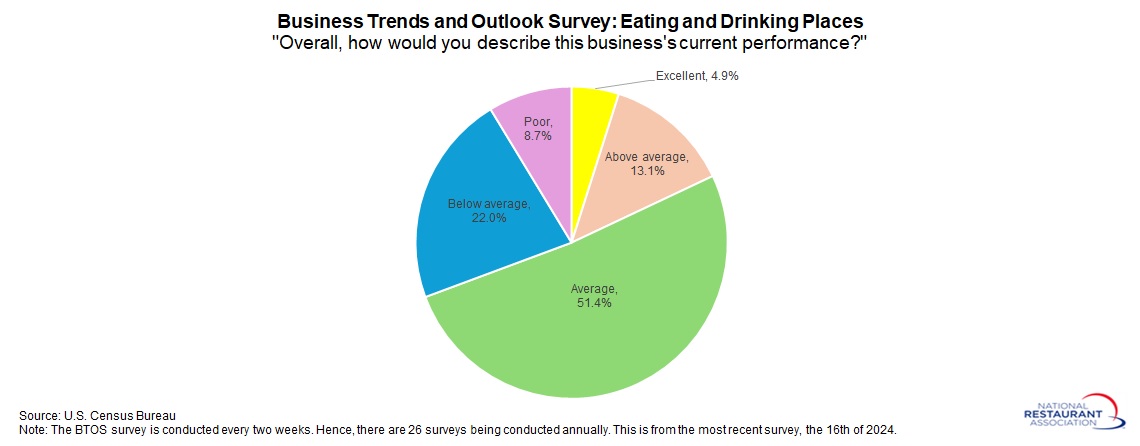
Similar to recent trends in the Restaurant Performance Index, the BTOS shows that conditions are challenging for eating and drinking places. While 51.4% of restaurants operators suggest that their business’s current performance is average in the latest survey (the 16th biweekly period in 2024), 30.7% suggest that conditions are either below average or poor while 18.0% feel that they are either above average or excellent. Moreover, those who were above average or excellent has slipped from 24.2% saying the same thing at the end of 2023, with 27.3% citing below average or poor conditions in the final survey of last years.
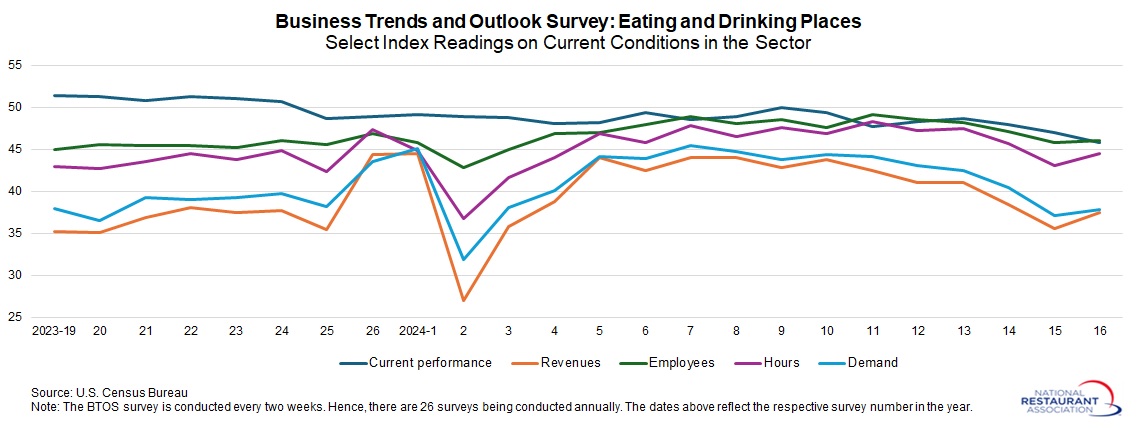
The result is that many of the key indices for the eating and drinking places sector have remained consistently below the key threshold of 50, reflecting more negative than positive sentiment. It is notable that restaurant operators began 2024 on a solidly negative note—including for revenues, employment, hours and demand—but conditions have stabilized somewhat since then, albeit still weaker than desired. In addition, the rate of decline lessened somewhat between the 15th and 16th biweekly survey for 2024.
While this might be disconcerting, one could also frame this more positively. In the latest survey, those restaurants feeling that their current performance was average, above average, or excellent totaled 69.4%. This perhaps suggests more resilience than not, even if conditions are weaker than ideal.
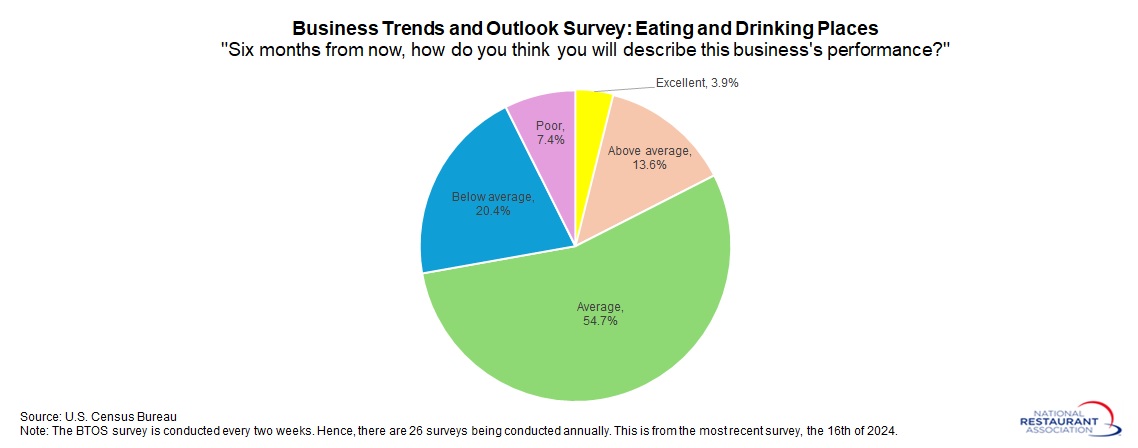
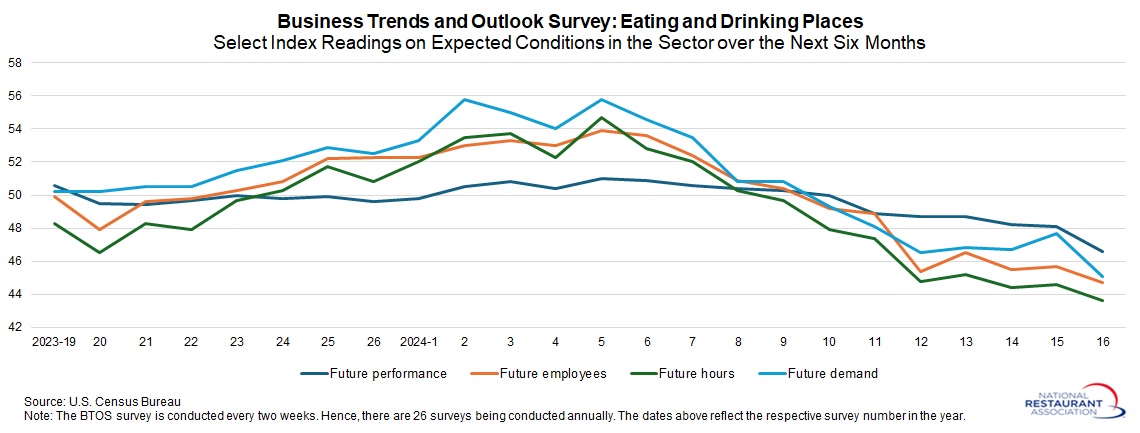
The future-oriented indices highlight the challenging expectations of respondents in the eating and drinking places sector for the next six months, with each of the key measures trending lower year to date.
The National Restaurant Association will continue to monitor this new experimental data set, providing insights on upcoming trends in the restaurant sector in this exciting survey development.
Track more economic indicators and read more analysis and commentary from the Association's economists.
More from Association's economists:
More from the Association's economists:
-
Research
New NRA Survey: Restaurants Stay a Priority as Financial Strains Challenge Spending
June 02, 2026This post summarizes the Q2 2026 Quarterly Consumer Insights Survey from the National Restaurant Association, showing both resilience and caution amid economic uncertainties. Thankfully, consumers continue to prioritize going out to eat even as they cut back in other spending categories. -
Research
Quarterly Consumer Insights Survey
June 02, 2026The National Restaurant Association’s latest Quarterly Consumer Insights Survey highlights a complex and evolving consumer landscape. -
Research
Restaurant Job Openings
June 02, 2026Restaurant and lodging job openings slowed in April -
Research
Same-store sales and customer traffic
May 29, 2026Restaurant operators reported mixed sales and traffic readings in April -
Articles
Taste of America: Regional chefs to celebrate country’s 250th
May 28, 2026Food festival, in partnership with National Archives Foundation, will showcase the history of U.S. restaurants. -
Research
GDP
May 28, 2026U.S. economy grew very modestly in Q1, up 1.6%, despite signs of caution -
Research
PCE Deflator
May 28, 2026Consumer inflation jumped in April; consumers dipped into savings to boost spending -
Research
Economic outlook
May 21, 2026U.S. economy poised to remain resilient in 2026 despite downside risks -
Research
GLP-1 and Restaurants: Shifting Habits, Not Shrinking Demand
May 20, 2026Restaurants remain deeply embedded in the lifestyles of GLP-1 users -
Articles
New and cool at the Show: Drinks, spices, alternative beef win the day
May 19, 2026THC-infused beverages, Dubai chocolate pastries, and plant-based protein take center stage.
-
Research
New NRA Survey: Restaurants Stay a Priority as Financial Strains Challenge Spending
June 02, 2026This post summarizes the Q2 2026 Quarterly Consumer Insights Survey from the National Restaurant Association, showing both resilience and caution amid economic uncertainties. Thankfully, consumers continue to prioritize going out to eat even as they cut back in other spending categories. -
Research
GLP-1 and Restaurants: Shifting Habits, Not Shrinking Demand
May 20, 2026Restaurants remain deeply embedded in the lifestyles of GLP-1 users -
Research
International tourism is projected to rebound this year after a 2025 decline
May 19, 2026Number of international visitors will remain well below the pre-pandemic peak