Research
June 24, 2026
Restaurants projected to add 450k seasonal jobs this summer
A decline in the restaurant industry’s prime labor pool may make hiring more challenging this summer.
Summer is the busiest season for restaurants in many parts of the country, and the stronger business leads to additional employment opportunities at all levels of a restaurant operation. These summer jobs are typically filled by a wide variety of individuals – teenagers, college students, teachers – even retirees who want to pick up a few shifts at the 19th hole of their local golf course.
Restaurants are expected to add 450,000 seasonal jobs this summer, according to the National Restaurant Association’s 28th annual Eating and Drinking Place Summer Employment Forecast. That would be down slightly from last summer’s increase of 469,000 seasonal jobs, and represent the third consecutive year in which summer hiring was below 500,000.
The uncertain business environment is contributing to the softer seasonal hiring, as restaurant operators continue to face uneven customer traffic. In addition, the industry’s prime labor pool – teenagers and young adults – is not as deep as it was last summer, which may lead to challenges filling some open positions.
At the same time, restaurant operators in some parts of the country will benefit from an expected uptick in international visitors – many of whom will be in the U.S. for the FIFA World Cup in June and July. However, even though some restaurants located in host cities will boost staffing to prepare for an increase in customer traffic during the 5-6 weeks of the tournament, it will likely not be evident in the summer employment numbers, which represent the average staffing levels between June and August.
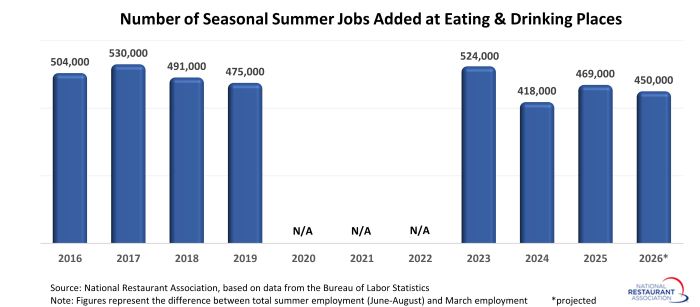
[Note: The 2020 – 2022 summers are excluded from the chart above because they were not typical hiring seasons. After losing millions of jobs during the early months of the pandemic, restaurants were still working to rebuild their teams back to pre-pandemic levels. As a result, it was not possible to distinguish between pandemic recovery and seasonal hiring during those three summers.]
Northeastern states will see the strongest summer job growth
Seasonal hiring varies significantly by state and is influenced by weather changes as well as the reliance on summer travel and tourism. For these reasons, states in the northeast typically see the strongest growth in seasonal restaurant jobs, as they are home to many restaurants that are only open during the summer season.
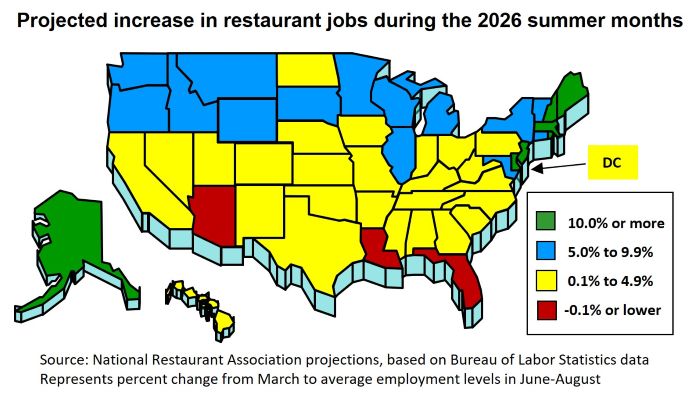
The states projected to register the largest proportional employment increase during the 2026 summer season are Maine (32%), Alaska (22%), Rhode Island (15%), Delaware (15%), Massachusetts (12%), New Hampshire (12%) and New Jersey (12%).
The states projected to add the most eating and drinking place jobs during the 2026 summer season are New York (42,100), California (33,500), New Jersey (31,400), Massachusetts (29,600), Illinois (23,300), Texas (22,400), Michigan (20,700) and North Carolina (19,500).
Due to the fact that their busiest seasons for travel and tourism are not in the summer months, Florida (-21,500), Arizona (-5,300) and Louisiana (-500) are projected to register declines in eating and drinking place employment during the 2026 summer season.
View the summer employment forecast for every state.
Prime labor pool is shallower in 2026
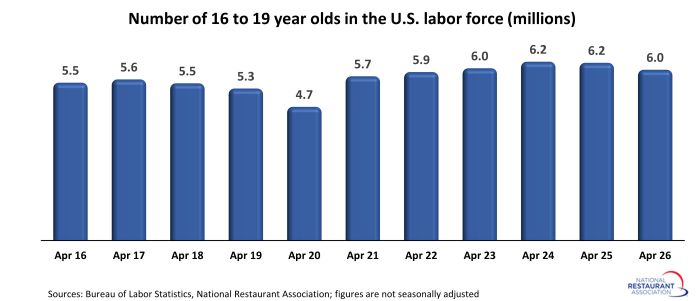
As the 2026 summer season approached, there was a decline in the restaurant industry’s prime labor pool. Roughly 6 million 16-19-year-olds were in the labor force in April, according to the Bureau of Labor Statistics (BLS). While that was 700,000 higher than the comparable pre-pandemic level in April 2019, it was 200,000 fewer teenagers than were in the labor force in both April 2024 and April 2025.
The number of teens in the workforce is still expected to rise well above 7 million during the peak summer months when more students are available, but the lower early-season numbers likely impacted some restaurant operators who were looking to get a jump on their seasonal hiring.
The availability of teens in the labor force is particularly important for restaurants, as this cohort makes up 20% of the industry workforce. Overall, restaurants are the economy’s largest employer of teenagers, providing job opportunities for more than 1.8 million 16-19-year-olds – or 33% of all working teens.
Young adults are also an important component of the restaurant workforce, with 20-24-year-olds accounting for 22% of all employees. Like the teenage cohort, restaurant operators who started ramping up their summer hiring in April had fewer of them to choose from than they did in 2025.
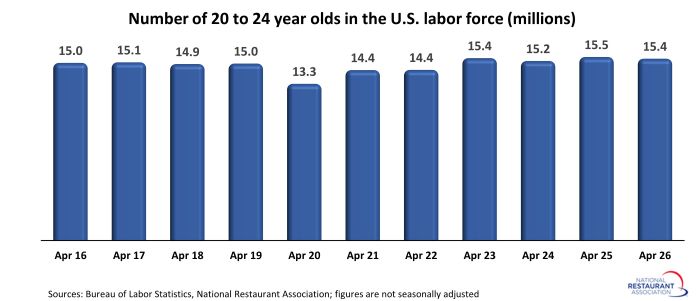
There were 15.4 million 20-24-year-olds in the labor force in April 2026 – down from 15.5 million in April 2025. That was largely the result of a lower labor force participation rate, which declined from 71.0% in April 2025 to 69.6% in April 2026.
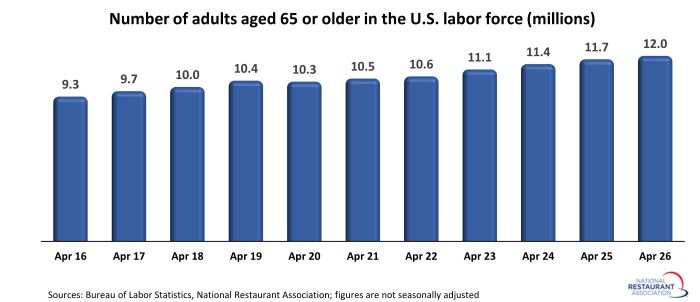
Restaurant operators looking for a more seasoned team this summer will likely have better luck, as the number of older adults in the labor pool continues to rise. There were 12.0 million adults aged 65 or older in the labor force in April 2026, according to BLS. That was up from 11.7 million in April 2025 and represented the highest April reading on record.
Although this age group makes up just 3% of the overall restaurant workforce, it will likely become more important in the coming years as their representation in the labor pool continues to rise. By 2034, BLS predicts there will be 14.5 million adults aged 65 or older in the labor force – an increase of more than 2.5 million above current levels.
Notes about the 2026 Eating and Drinking Place Summer Employment Forecast:
Restaurants are expected to add 450,000 seasonal jobs this summer, according to the National Restaurant Association’s 28th annual Eating and Drinking Place Summer Employment Forecast. That would be down slightly from last summer’s increase of 469,000 seasonal jobs, and represent the third consecutive year in which summer hiring was below 500,000.
The uncertain business environment is contributing to the softer seasonal hiring, as restaurant operators continue to face uneven customer traffic. In addition, the industry’s prime labor pool – teenagers and young adults – is not as deep as it was last summer, which may lead to challenges filling some open positions.
At the same time, restaurant operators in some parts of the country will benefit from an expected uptick in international visitors – many of whom will be in the U.S. for the FIFA World Cup in June and July. However, even though some restaurants located in host cities will boost staffing to prepare for an increase in customer traffic during the 5-6 weeks of the tournament, it will likely not be evident in the summer employment numbers, which represent the average staffing levels between June and August.
[Note: The 2020 – 2022 summers are excluded from the chart above because they were not typical hiring seasons. After losing millions of jobs during the early months of the pandemic, restaurants were still working to rebuild their teams back to pre-pandemic levels. As a result, it was not possible to distinguish between pandemic recovery and seasonal hiring during those three summers.]
Northeastern states will see the strongest summer job growth
Seasonal hiring varies significantly by state and is influenced by weather changes as well as the reliance on summer travel and tourism. For these reasons, states in the northeast typically see the strongest growth in seasonal restaurant jobs, as they are home to many restaurants that are only open during the summer season.
The states projected to register the largest proportional employment increase during the 2026 summer season are Maine (32%), Alaska (22%), Rhode Island (15%), Delaware (15%), Massachusetts (12%), New Hampshire (12%) and New Jersey (12%).
The states projected to add the most eating and drinking place jobs during the 2026 summer season are New York (42,100), California (33,500), New Jersey (31,400), Massachusetts (29,600), Illinois (23,300), Texas (22,400), Michigan (20,700) and North Carolina (19,500).
Due to the fact that their busiest seasons for travel and tourism are not in the summer months, Florida (-21,500), Arizona (-5,300) and Louisiana (-500) are projected to register declines in eating and drinking place employment during the 2026 summer season.
View the summer employment forecast for every state.
Prime labor pool is shallower in 2026
As the 2026 summer season approached, there was a decline in the restaurant industry’s prime labor pool. Roughly 6 million 16-19-year-olds were in the labor force in April, according to the Bureau of Labor Statistics (BLS). While that was 700,000 higher than the comparable pre-pandemic level in April 2019, it was 200,000 fewer teenagers than were in the labor force in both April 2024 and April 2025.
The number of teens in the workforce is still expected to rise well above 7 million during the peak summer months when more students are available, but the lower early-season numbers likely impacted some restaurant operators who were looking to get a jump on their seasonal hiring.
The availability of teens in the labor force is particularly important for restaurants, as this cohort makes up 20% of the industry workforce. Overall, restaurants are the economy’s largest employer of teenagers, providing job opportunities for more than 1.8 million 16-19-year-olds – or 33% of all working teens.
Young adults are also an important component of the restaurant workforce, with 20-24-year-olds accounting for 22% of all employees. Like the teenage cohort, restaurant operators who started ramping up their summer hiring in April had fewer of them to choose from than they did in 2025.
There were 15.4 million 20-24-year-olds in the labor force in April 2026 – down from 15.5 million in April 2025. That was largely the result of a lower labor force participation rate, which declined from 71.0% in April 2025 to 69.6% in April 2026.
Restaurant operators looking for a more seasoned team this summer will likely have better luck, as the number of older adults in the labor pool continues to rise. There were 12.0 million adults aged 65 or older in the labor force in April 2026, according to BLS. That was up from 11.7 million in April 2025 and represented the highest April reading on record.
Although this age group makes up just 3% of the overall restaurant workforce, it will likely become more important in the coming years as their representation in the labor pool continues to rise. By 2034, BLS predicts there will be 14.5 million adults aged 65 or older in the labor force – an increase of more than 2.5 million above current levels.
Notes about the 2026 Eating and Drinking Place Summer Employment Forecast:
- Eating and drinking places are the primary component of the restaurant and foodservice industry, which the National Restaurant Association defines as that which encompasses all meals and snacks prepared away from home. Eating and drinking places account for approximately three-fourths of the total restaurant and foodservice workforce.
- Summer employment is defined as the average number of eating and drinking place jobs in June, July and August.
- The number of summer jobs is the difference between the projected total 2026 summer employment and the March 2026 employment level.
- Generally, the U.S. restaurant industry begins to ramp up its summer seasonal hiring in April, and it peaks in June, July and August.
- The restaurant industry is typically the nation’s second largest creator of seasonal jobs during the summer months – ranking only behind the construction industry.