Research
May 19, 2026
International tourism is projected to rebound this year after a 2025 decline
Number of international visitors will remain well below the pre-pandemic peak
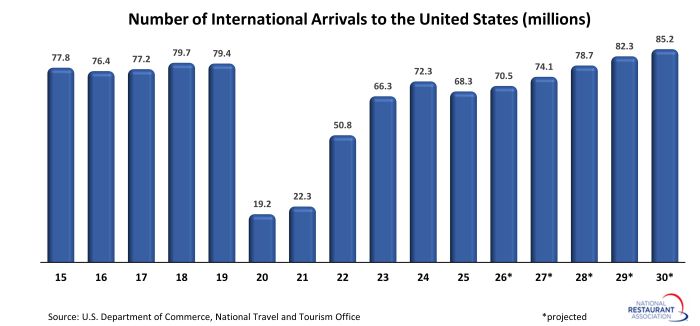
The number of international arrivals to the United States is expected to total 70.5 million in 2026, according to new projections from the National Travel and Tourism Office (NTTO) within the U.S. Department of Commerce.
That would be over 2 million more visitors than came to the U.S. in 2025, and would provide a much needed boost to tourism-dependent sectors like restaurants. Part of the uptick in international visitors will be driven by the FIFA World Cup, which will be held in the U.S. (as well as Canada and Mexico) in June and July.
Despite the projected increase in 2026, the number of international arrivals would remain below 2024’s total of 72.3 million. In addition, it would be more than 9 million fewer than the record high of 79.7 million visitors in 2018. Based on current projections, international arrivals won’t surpass their 2018 peak until 2029.
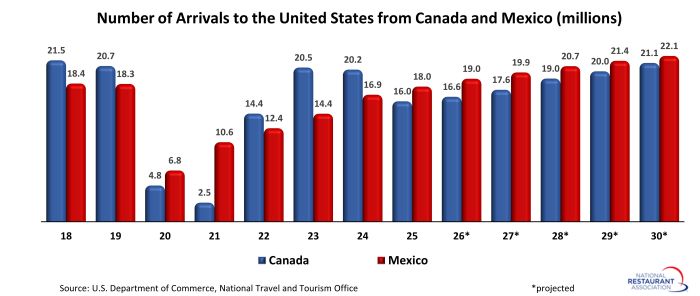
Canada and Mexico are historically the top 2 countries of origin for visitors to the U.S., and that trend will continue in 2026. The U.S. is projected to draw 16.6 million visitors from Canada this year. While that would be 600,000 higher than 2025, it would be nearly 4 million fewer than the number of people that visited in both 2023 and 2024. Based on NTTO’s projections, the number of Canadian arrivals will not return to 2023 and 2024 levels until 2030.
Unlike Canada, the number of arrivals from Mexico has risen steadily since its pandemic low of just 6.8 million in 2020. NTTO expects the U.S. to welcome 19 million visitors from Mexico in 2026 – up 1 million from 2025. That would also surpass pre-pandemic levels, and would match 2016 (also 19 million) as the highest number of arrivals from Mexico on record.
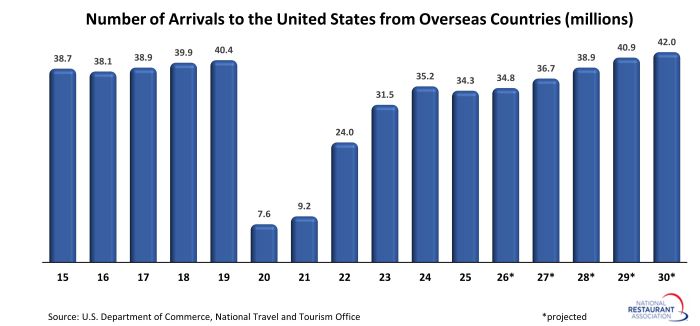
NTTO is also forecasting a modest increase in the number of overseas visitors to the U.S. in 2026. Arrivals from overseas countries are projected to total 34.8 million this year, up from 34.3 million in 2025. That would still be slightly below 2024’s levels, and nearly 6 million fewer than the record of 40.4 million overseas arrivals in 2019.
The top 8 countries of origin for overseas arrivals in 2026 are projected to be the United Kingdom (4.2 million), Japan (2.1 million), Brazil (2.0 million), India (2.0 million), Germany (1.8 million), South Korea (1.7 million), China (1.6 million) and France (1.6 million).
Importance of tourism for restaurants
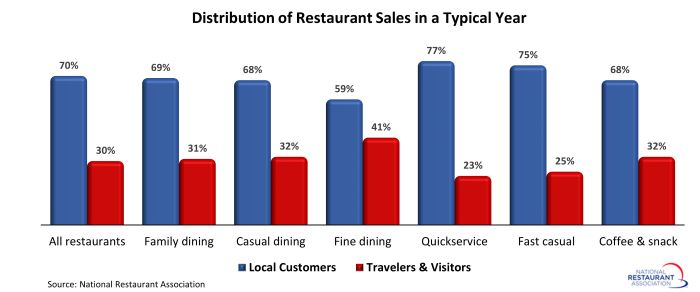
In a typical year, 3 out of every 10 dollars spent at U.S. restaurants comes from travelers and visitors (domestic and international combined), according to National Restaurant Association research. While this varies significantly by segment and region of the country, virtually all restaurants derive at least some of their sales from customers who live outside of their area.
The reliance on tourism is highest in the fine dining segment, with an average of 41% of sales coming from travelers and visitors. For some fine dining restaurants, it is a significantly larger proportion: 1 in 4 fine dining operators say visitors account for at least 60% of their annual sales.
In the family dining, casual dining and coffee-and-snack segments, roughly one-third of sales come from travelers and visitors. Travelers and visitors account for 1 in 4 dollars spent in the quickservice and fast casual segments.
Based on NTTO’s estimates, there were 4 million fewer international arrivals in 2025 than there were in 2024. That had a direct impact on travel and tourism sales at restaurants – exacerbating an already challenging business environment.
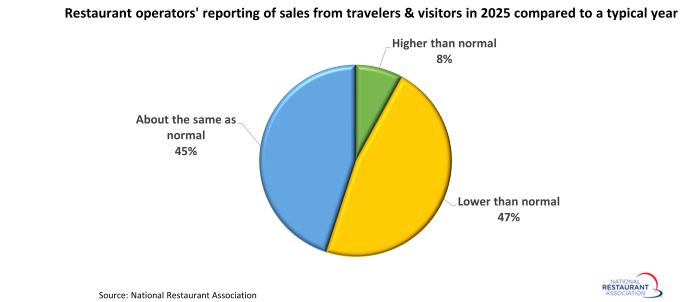
Forty-seven percent of restaurant operators said their sales from travelers and visitors (both domestic and international) in 2025 were lower than they would normally be in a typical year. Only 8% of operators said their tourism-related sales were higher in 2025, while 45% said they were about the same as normal.
A rebound in spending by travelers would be a welcome sight for restaurants, particularly for those in areas that are frequented by international visitors.
That would be over 2 million more visitors than came to the U.S. in 2025, and would provide a much needed boost to tourism-dependent sectors like restaurants. Part of the uptick in international visitors will be driven by the FIFA World Cup, which will be held in the U.S. (as well as Canada and Mexico) in June and July.
Despite the projected increase in 2026, the number of international arrivals would remain below 2024’s total of 72.3 million. In addition, it would be more than 9 million fewer than the record high of 79.7 million visitors in 2018. Based on current projections, international arrivals won’t surpass their 2018 peak until 2029.
Canada and Mexico are historically the top 2 countries of origin for visitors to the U.S., and that trend will continue in 2026. The U.S. is projected to draw 16.6 million visitors from Canada this year. While that would be 600,000 higher than 2025, it would be nearly 4 million fewer than the number of people that visited in both 2023 and 2024. Based on NTTO’s projections, the number of Canadian arrivals will not return to 2023 and 2024 levels until 2030.
Unlike Canada, the number of arrivals from Mexico has risen steadily since its pandemic low of just 6.8 million in 2020. NTTO expects the U.S. to welcome 19 million visitors from Mexico in 2026 – up 1 million from 2025. That would also surpass pre-pandemic levels, and would match 2016 (also 19 million) as the highest number of arrivals from Mexico on record.
NTTO is also forecasting a modest increase in the number of overseas visitors to the U.S. in 2026. Arrivals from overseas countries are projected to total 34.8 million this year, up from 34.3 million in 2025. That would still be slightly below 2024’s levels, and nearly 6 million fewer than the record of 40.4 million overseas arrivals in 2019.
The top 8 countries of origin for overseas arrivals in 2026 are projected to be the United Kingdom (4.2 million), Japan (2.1 million), Brazil (2.0 million), India (2.0 million), Germany (1.8 million), South Korea (1.7 million), China (1.6 million) and France (1.6 million).
Importance of tourism for restaurants
In a typical year, 3 out of every 10 dollars spent at U.S. restaurants comes from travelers and visitors (domestic and international combined), according to National Restaurant Association research. While this varies significantly by segment and region of the country, virtually all restaurants derive at least some of their sales from customers who live outside of their area.
The reliance on tourism is highest in the fine dining segment, with an average of 41% of sales coming from travelers and visitors. For some fine dining restaurants, it is a significantly larger proportion: 1 in 4 fine dining operators say visitors account for at least 60% of their annual sales.
In the family dining, casual dining and coffee-and-snack segments, roughly one-third of sales come from travelers and visitors. Travelers and visitors account for 1 in 4 dollars spent in the quickservice and fast casual segments.
Based on NTTO’s estimates, there were 4 million fewer international arrivals in 2025 than there were in 2024. That had a direct impact on travel and tourism sales at restaurants – exacerbating an already challenging business environment.
Forty-seven percent of restaurant operators said their sales from travelers and visitors (both domestic and international) in 2025 were lower than they would normally be in a typical year. Only 8% of operators said their tourism-related sales were higher in 2025, while 45% said they were about the same as normal.
A rebound in spending by travelers would be a welcome sight for restaurants, particularly for those in areas that are frequented by international visitors.