Research
July 22, 2026
Restaurants remain resilient despite challenging business conditions
The National Restaurant Association expects the operating environment to improve during the second half of 2026
Business conditions for restaurants proved to be more challenging than expected during the first half of the year, driven largely by sharply higher gas prices. The national average for a gallon of regular gasoline stood above $4 for nearly three months, before dropping below that threshold in mid-June. That put additional strain on household budgets, many of which were already struggling to cover monthly expenses.
Fortunately for discretionary categories like restaurants, many consumers were able to use this year’s sizable tax refunds to cushion the impact of higher gas prices. While that supported continued spending in the immediate term, it likely resulted in a faster depletion of one of this year’s top expected catalysts for the economy.
Even with the added wallet competition of higher pump prices, many consumers continued to prioritize restaurants in their spending decisions. That’s because a solid majority of consumers feel generally positive about their personal financial situation, which gives them confidence to continue spending.
Consumers’ connection to restaurants is reflected in the Association’s Summer Travel and Dining Report, which found that 98% of travelers plan to use restaurants during the summer trips this year. That makes visiting restaurants the most popular activity for summer travelers, ranking ahead of shopping, sightseeing, and going to the beach. Specific to this summer, 55% of consumers indicated that they plan to vacation or take a personal trip within the U.S. that includes at least one overnight stay, and that is encouraging news for restaurants.
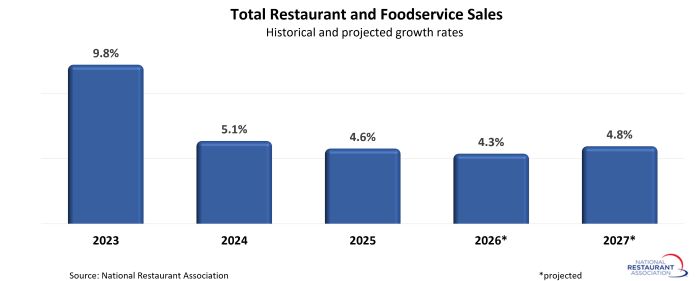
Despite the challenging business conditions, restaurant sales will continue to rise in 2026, albeit at a somewhat slower pace than forecast to start the year. The National Restaurant Association expects total restaurant and foodservice sales to increase 4.3% in 2026, a half percentage point below the 4.8% gain projected at the beginning of the year.
At the same time, customer traffic levels remain uneven, which means much of the sales growth is driven by higher menu prices – a continued necessity due to higher costs across the restaurant operation. In inflation-adjusted terms, restaurant sales are projected to increase 0.8% in 2026. That compares to a 1.3% increase forecast in early 2026.
Looking ahead to 2027, the National Restaurant Association anticipates sales will remain resilient, with growth expected to strengthen to 4.8%. As new data becomes available, this outlook may be revised in conjunction with the release of the 2027 State of the Restaurant Industry report early next year.
Restaurant operating costs remain elevated, which continues to negatively impact profitability
Food and labor costs are the two most significant line items for a restaurant, each accounting for approximately 33 cents of every dollar in sales. While their growth rates moderated somewhat during the first half of 2026, both remain significantly elevated compared to pre-pandemic levels. Average hourly earnings of restaurant employees have risen 41% since February 2020, while average wholesale food prices are up 35%.
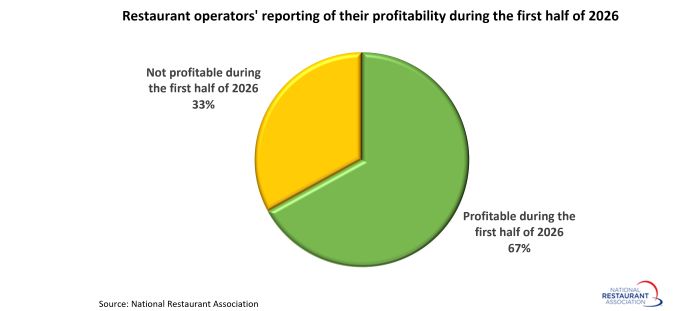
At the same time, operators are also contending with sharply higher expenses for insurance, taxes, credit card swipe fees, and other inputs. With that as a backdrop, it’s not surprising that 33% of operators said their restaurant was not profitable during the first half of 2026.
Looking ahead to the second half of the year, food and labor costs are expected to remain elevated, putting additional pressure on margins. In response, restaurant operators will need to remain focused on improving efficiency and productivity across various aspects of their operations while identifying opportunities to manage costs.
Restaurants continue to expand employment opportunities
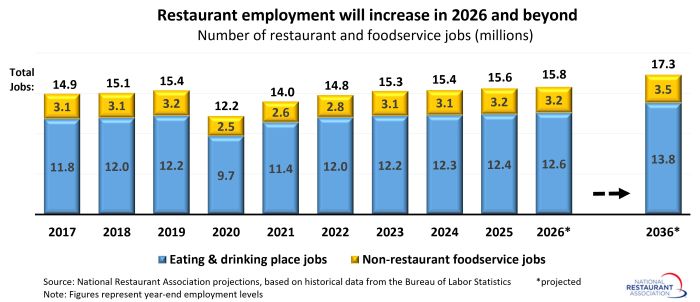
Restaurants have been the one of the top job creators in the U.S. economy, adding more than 125,000 jobs during the last 12 months.
The solid job growth occurred despite a decline in one of the restaurant industry’s prime labor pools. On average during first half of 2026, there were roughly 250,000 fewer 16-19-year-olds in the labor force than there were during the same period in 2025, according to the Bureau of Labor Statistics.
The availability of teens in the labor force is particularly important for restaurants, as this cohort makes up 20% of the industry workforce. Overall, restaurants are the economy’s largest employer of teenagers, providing job opportunities for more than 1.8 million 16-19-year-olds – or 33% of all working teens.
On the segment level, both fullservice and limited-service restaurants expanded payrolls during the first half of 2026. However, the fullservice segment has yet to fully recover from the 3.7 million jobs that were lost during the first two months of the pandemic, with staffing levels still nearly 200,000 jobs below pre-pandemic readings.
Looking ahead to the second half of 2026, the expectation is that restaurant employment will continue to rise. Restaurant operators will continue to balance staffing levels with ever-changing business conditions and remain nimble if there is any deterioration in consumers’ ability to spend.
Economic outlook is cautiously optimistic for the second half of 2026
After a bumpy first half of 2026, economic conditions are projected to improve during the last six months of the year. Most notable is the expectation of lower gasoline prices, which spent nearly three months above $4. That should ease the pressure on household budgets, providing some support for restaurant traffic and broader consumer spending.
The resurgent U.S. labor market should also buoy growth, hopefully helping to boost spirits among jittery consumers. Employers added more than a half-million jobs during the first six months of 2026 – a pace of payroll expansion not seen in nearly two years. When employment is strong and wages are rising, consumer spending typically remains resilient, including discretionary categories such as restaurants.
Inflation, however, remains a complicating factor. The Personal Consumption Expenditures (PCE) deflator – the Federal Reserve’s preferred measure of inflation – increased 4.1% on a year-over-year basis in May, the fastest pace of inflation since April 2023. Core PCE inflation, which excludes food and energy, edged higher from 3.3% to 3.4%, its highest reading since October 2023.
Overall, inflation remains persistently elevated and is moving in an unfavorable direction. This poses a challenge for the Federal Reserve, especially as price growth continues to drift further from its long-run 2% target. Policymakers have struck a more hawkish tone in recent communications, reflecting renewed concern about inflation. While interest rates are likely to remain unchanged in the near term, there is growing speculation that rates may need to rise later this year if inflation continues to run above levels deemed acceptable by the Federal Open Market Committee.
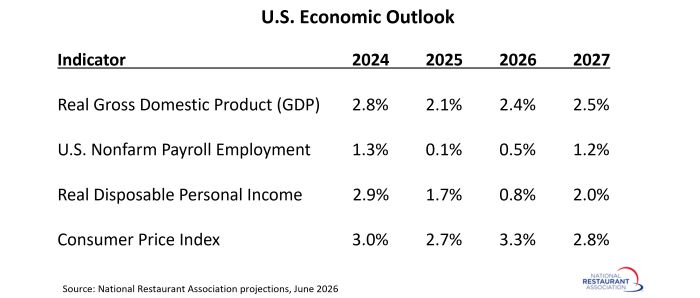
Looking ahead to the second half of the year, consumers will likely benefit from declining pump prices, as well as continued growth in employment and wages. The National Restaurant Association forecasts real GDP growth of 2.4% in 2026, above the 2.1% pace in 2025. The expectation is that the U.S. economy will add more than 1 million net new jobs this year – a solid improvement from last year’s modest employment growth. The current forecast is for 2.5% growth in the U.S. economy in 2027.
Restaurant operators have a cautiously positive outlook for the remainder of 2026
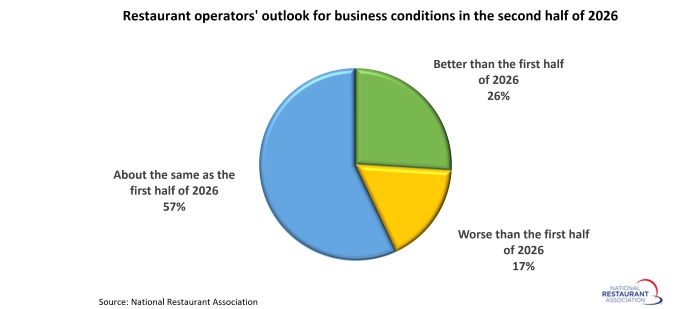
For their part, restaurant operators are cautiously optimistic about business conditions during the second half of 2026. Twenty-six percent of operators think business conditions will improve during the second half of the year, while 17% expect conditions to worsen.
The remaining 57% of operators think business conditions during the second half of 2026 will be about the same as they were during the first six months of the year.
Fortunately for discretionary categories like restaurants, many consumers were able to use this year’s sizable tax refunds to cushion the impact of higher gas prices. While that supported continued spending in the immediate term, it likely resulted in a faster depletion of one of this year’s top expected catalysts for the economy.
Even with the added wallet competition of higher pump prices, many consumers continued to prioritize restaurants in their spending decisions. That’s because a solid majority of consumers feel generally positive about their personal financial situation, which gives them confidence to continue spending.
Consumers’ connection to restaurants is reflected in the Association’s Summer Travel and Dining Report, which found that 98% of travelers plan to use restaurants during the summer trips this year. That makes visiting restaurants the most popular activity for summer travelers, ranking ahead of shopping, sightseeing, and going to the beach. Specific to this summer, 55% of consumers indicated that they plan to vacation or take a personal trip within the U.S. that includes at least one overnight stay, and that is encouraging news for restaurants.
Despite the challenging business conditions, restaurant sales will continue to rise in 2026, albeit at a somewhat slower pace than forecast to start the year. The National Restaurant Association expects total restaurant and foodservice sales to increase 4.3% in 2026, a half percentage point below the 4.8% gain projected at the beginning of the year.
At the same time, customer traffic levels remain uneven, which means much of the sales growth is driven by higher menu prices – a continued necessity due to higher costs across the restaurant operation. In inflation-adjusted terms, restaurant sales are projected to increase 0.8% in 2026. That compares to a 1.3% increase forecast in early 2026.
Looking ahead to 2027, the National Restaurant Association anticipates sales will remain resilient, with growth expected to strengthen to 4.8%. As new data becomes available, this outlook may be revised in conjunction with the release of the 2027 State of the Restaurant Industry report early next year.
Restaurant operating costs remain elevated, which continues to negatively impact profitability
Food and labor costs are the two most significant line items for a restaurant, each accounting for approximately 33 cents of every dollar in sales. While their growth rates moderated somewhat during the first half of 2026, both remain significantly elevated compared to pre-pandemic levels. Average hourly earnings of restaurant employees have risen 41% since February 2020, while average wholesale food prices are up 35%.
At the same time, operators are also contending with sharply higher expenses for insurance, taxes, credit card swipe fees, and other inputs. With that as a backdrop, it’s not surprising that 33% of operators said their restaurant was not profitable during the first half of 2026.
Looking ahead to the second half of the year, food and labor costs are expected to remain elevated, putting additional pressure on margins. In response, restaurant operators will need to remain focused on improving efficiency and productivity across various aspects of their operations while identifying opportunities to manage costs.
Restaurants continue to expand employment opportunities
Restaurants have been the one of the top job creators in the U.S. economy, adding more than 125,000 jobs during the last 12 months.
The solid job growth occurred despite a decline in one of the restaurant industry’s prime labor pools. On average during first half of 2026, there were roughly 250,000 fewer 16-19-year-olds in the labor force than there were during the same period in 2025, according to the Bureau of Labor Statistics.
The availability of teens in the labor force is particularly important for restaurants, as this cohort makes up 20% of the industry workforce. Overall, restaurants are the economy’s largest employer of teenagers, providing job opportunities for more than 1.8 million 16-19-year-olds – or 33% of all working teens.
On the segment level, both fullservice and limited-service restaurants expanded payrolls during the first half of 2026. However, the fullservice segment has yet to fully recover from the 3.7 million jobs that were lost during the first two months of the pandemic, with staffing levels still nearly 200,000 jobs below pre-pandemic readings.
Looking ahead to the second half of 2026, the expectation is that restaurant employment will continue to rise. Restaurant operators will continue to balance staffing levels with ever-changing business conditions and remain nimble if there is any deterioration in consumers’ ability to spend.
Economic outlook is cautiously optimistic for the second half of 2026
After a bumpy first half of 2026, economic conditions are projected to improve during the last six months of the year. Most notable is the expectation of lower gasoline prices, which spent nearly three months above $4. That should ease the pressure on household budgets, providing some support for restaurant traffic and broader consumer spending.
The resurgent U.S. labor market should also buoy growth, hopefully helping to boost spirits among jittery consumers. Employers added more than a half-million jobs during the first six months of 2026 – a pace of payroll expansion not seen in nearly two years. When employment is strong and wages are rising, consumer spending typically remains resilient, including discretionary categories such as restaurants.
Inflation, however, remains a complicating factor. The Personal Consumption Expenditures (PCE) deflator – the Federal Reserve’s preferred measure of inflation – increased 4.1% on a year-over-year basis in May, the fastest pace of inflation since April 2023. Core PCE inflation, which excludes food and energy, edged higher from 3.3% to 3.4%, its highest reading since October 2023.
Overall, inflation remains persistently elevated and is moving in an unfavorable direction. This poses a challenge for the Federal Reserve, especially as price growth continues to drift further from its long-run 2% target. Policymakers have struck a more hawkish tone in recent communications, reflecting renewed concern about inflation. While interest rates are likely to remain unchanged in the near term, there is growing speculation that rates may need to rise later this year if inflation continues to run above levels deemed acceptable by the Federal Open Market Committee.
Looking ahead to the second half of the year, consumers will likely benefit from declining pump prices, as well as continued growth in employment and wages. The National Restaurant Association forecasts real GDP growth of 2.4% in 2026, above the 2.1% pace in 2025. The expectation is that the U.S. economy will add more than 1 million net new jobs this year – a solid improvement from last year’s modest employment growth. The current forecast is for 2.5% growth in the U.S. economy in 2027.
Restaurant operators have a cautiously positive outlook for the remainder of 2026
For their part, restaurant operators are cautiously optimistic about business conditions during the second half of 2026. Twenty-six percent of operators think business conditions will improve during the second half of the year, while 17% expect conditions to worsen.
The remaining 57% of operators think business conditions during the second half of 2026 will be about the same as they were during the first six months of the year.