Research
April 07, 2026
Potential Workers on the Sidelines: Labor Force Participation Continues to Slide
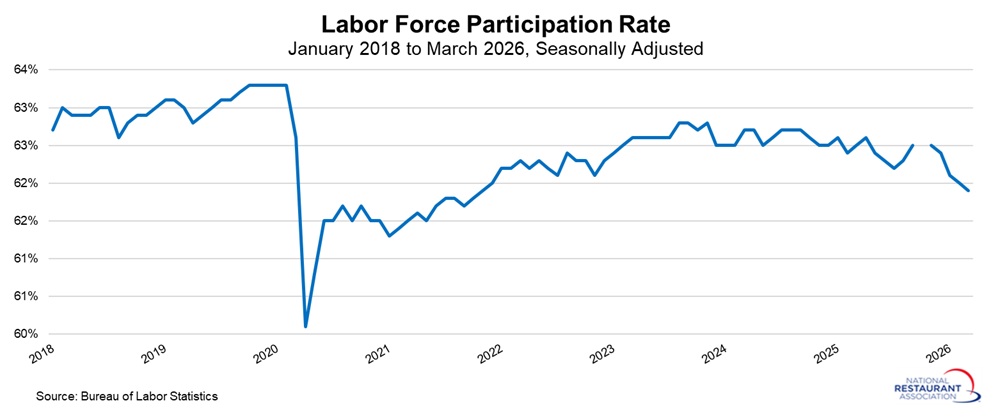
In November 2023, the labor force participation rate reached 62.8%, marking the third time in four months that year it hit that level. Those readings were the strongest since February 2020 (63.3%), signaling that more people were re-entering the workforce and helping to ease labor shortages in the wake of the pandemic. This was welcome news for restaurants and other businesses struggling to recruit and retain employees, and a stronger labor market provided added resilience for the U.S. economy.
That period coincided with the height of the so called “Great Resignation,” when the labor market was so tight there were roughly two job openings for every unemployed worker. Since then, conditions have cooled considerably, giving way to what can be described as the “Great Stay,” with both workers and employers settling into a holding pattern marked by less job switching.
In today’s labor market, more potential workers have also moved to the sidelines. The civilian labor force has contracted sharply over the past year, falling from 128.69 million in March 2025 to 123.84 million in March 2026. At the same time, the labor force participation rate edged down from 62.0% in February to 61.9% in March, the lowest level since November 2021.
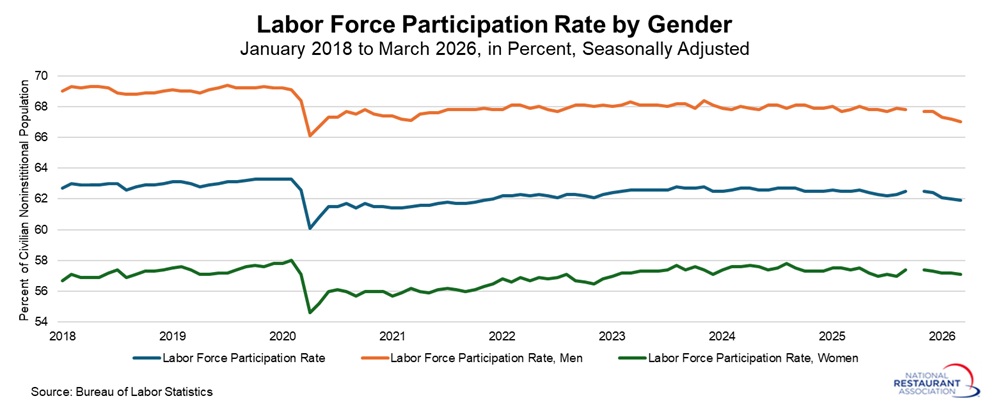
By gender, labor force participation has declined for both men and women over the past year or so, though the pace of decline has been notably steeper for men. Among males, the participation rate peaked at 68.4% in November 2023, the highest level since March 2020, before sliding to 67.0% in March 2026. That represents a 0.8 percentage point decline over the past 12 months and the lowest reading since May 2020.
Among women, labor force participation peaked at 57.8% in August 2024 and has since edged down to 57.1% in March 2026. Unlike the sharper pullback seen among men, the female participation rate has largely stabilized over the past year, averaging 57.2% across the past ten readings.
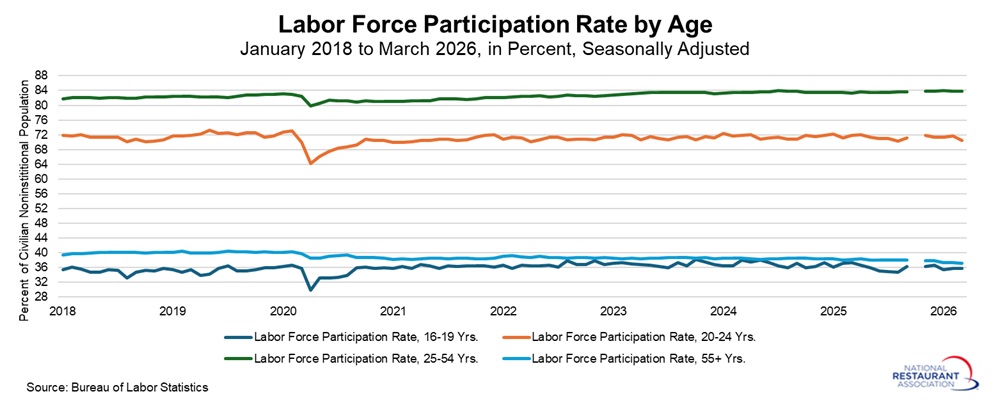
The steepest labor force participation declines have been among those younger than 25 and those 55 or older. For teenagers (16–19), participation peaked post-pandemic at 38.2% in October 2023 but fell to 34.8% in August 2024, the lowest since August 2020. It has picked up somewhat since then, measuring 35.7% in both February and March 2026, which was also the average seen over the past nine readings.
Among young adults (20–24), participation has also trended lower, slipping from 72.3% in January 2024, the highest since October 2019, to 70.5% in March 2026. That was the second-lowest reading—with the other being 70.3% in August 2025—since early 2021.
For workers 55 and older, demographic factors are key, with more individuals retiring, particularly since the pandemic. In February 2020, participation for this group was 40.3%, near the record high of 40.7% set in late 2012 and early 2013. That share dropped to 37.2% in March 2026, the lowest since June 2025.
By contrast, participation among “prime-age” workers (25–54) has held relatively steady, averaging 83.6% since January 2024 and registering 83.8% in March 2026. It hit 84.0% in January, the highest since March 2001, with the current rate just shy of that recent peak.
These findings reinforce a clear post pandemic trend: young men remain the most likely to be on the sidelines of the labor force. This underscores the need for policymakers and businesses alike to develop strategies to draw more of them back into the labor market—efforts that could help ease workforce shortages by expanding the overall supply of labor.
This challenge carries particular significance for the restaurant industry, which has long served as the nation’s primary training ground. More than half of all U.S. adults held their first job in a restaurant, and more than 67% have worked in the industry at some point in their lives. Simply put, restaurants have influenced the career paths of more people than any other sector.
As labor force participation among young people declines, fewer teenagers are gaining access to those formative early work experiences, and the essential skills that come with them, which have lasting implications for both individual career trajectories and the broader economy. At the same time, the lack of participation among this group represents a tremendous opportunity for restaurants and other businesses as they are looking for potential workers to meet their staffing needs.
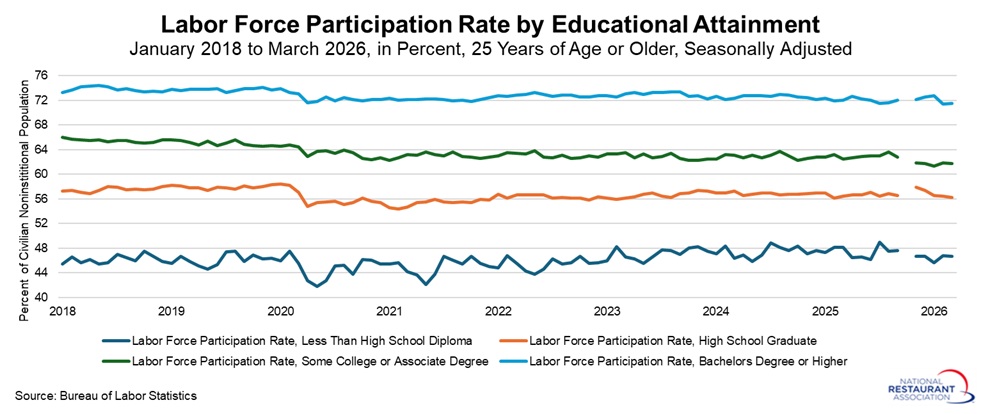
Perhaps more striking is the trend among those with at least a bachelor’s degree. Labor force participation for the most educated workers fell to 71.4% in February 2026, a record low in data dating back to 1992, before ticking up only marginally to 71.5% in March. This pattern likely reflects efficiency-driven staffing reductions across both the private and public sectors, pointing to a more challenging labor market even for higher skilled workers. It also aligns with widespread anecdotal reports that finding employment today is more difficult than it was a year or two ago.
That period coincided with the height of the so called “Great Resignation,” when the labor market was so tight there were roughly two job openings for every unemployed worker. Since then, conditions have cooled considerably, giving way to what can be described as the “Great Stay,” with both workers and employers settling into a holding pattern marked by less job switching.
In today’s labor market, more potential workers have also moved to the sidelines. The civilian labor force has contracted sharply over the past year, falling from 128.69 million in March 2025 to 123.84 million in March 2026. At the same time, the labor force participation rate edged down from 62.0% in February to 61.9% in March, the lowest level since November 2021.
By gender, labor force participation has declined for both men and women over the past year or so, though the pace of decline has been notably steeper for men. Among males, the participation rate peaked at 68.4% in November 2023, the highest level since March 2020, before sliding to 67.0% in March 2026. That represents a 0.8 percentage point decline over the past 12 months and the lowest reading since May 2020.
Among women, labor force participation peaked at 57.8% in August 2024 and has since edged down to 57.1% in March 2026. Unlike the sharper pullback seen among men, the female participation rate has largely stabilized over the past year, averaging 57.2% across the past ten readings.
The steepest labor force participation declines have been among those younger than 25 and those 55 or older. For teenagers (16–19), participation peaked post-pandemic at 38.2% in October 2023 but fell to 34.8% in August 2024, the lowest since August 2020. It has picked up somewhat since then, measuring 35.7% in both February and March 2026, which was also the average seen over the past nine readings.
Among young adults (20–24), participation has also trended lower, slipping from 72.3% in January 2024, the highest since October 2019, to 70.5% in March 2026. That was the second-lowest reading—with the other being 70.3% in August 2025—since early 2021.
For workers 55 and older, demographic factors are key, with more individuals retiring, particularly since the pandemic. In February 2020, participation for this group was 40.3%, near the record high of 40.7% set in late 2012 and early 2013. That share dropped to 37.2% in March 2026, the lowest since June 2025.
By contrast, participation among “prime-age” workers (25–54) has held relatively steady, averaging 83.6% since January 2024 and registering 83.8% in March 2026. It hit 84.0% in January, the highest since March 2001, with the current rate just shy of that recent peak.
These findings reinforce a clear post pandemic trend: young men remain the most likely to be on the sidelines of the labor force. This underscores the need for policymakers and businesses alike to develop strategies to draw more of them back into the labor market—efforts that could help ease workforce shortages by expanding the overall supply of labor.
This challenge carries particular significance for the restaurant industry, which has long served as the nation’s primary training ground. More than half of all U.S. adults held their first job in a restaurant, and more than 67% have worked in the industry at some point in their lives. Simply put, restaurants have influenced the career paths of more people than any other sector.
As labor force participation among young people declines, fewer teenagers are gaining access to those formative early work experiences, and the essential skills that come with them, which have lasting implications for both individual career trajectories and the broader economy. At the same time, the lack of participation among this group represents a tremendous opportunity for restaurants and other businesses as they are looking for potential workers to meet their staffing needs.
Perhaps more striking is the trend among those with at least a bachelor’s degree. Labor force participation for the most educated workers fell to 71.4% in February 2026, a record low in data dating back to 1992, before ticking up only marginally to 71.5% in March. This pattern likely reflects efficiency-driven staffing reductions across both the private and public sectors, pointing to a more challenging labor market even for higher skilled workers. It also aligns with widespread anecdotal reports that finding employment today is more difficult than it was a year or two ago.