Rising food costs + tight supplies = more challenges for industry
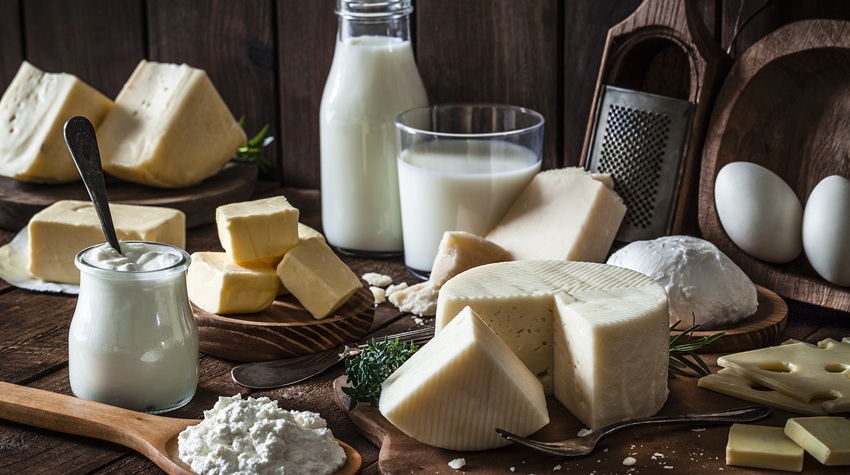
This year, milk and cheese supplies are expected to increase, potentially softening prices, but butter markets may tighten.
This year, the U.S. restaurant industry continues to face mounting challenges as operators grapple with the same elevated food and labor costs, ongoing supply chain disruptions, and policy-driven pressures they did in 2025, according to research from the National Restaurant Association.
Its 2026 State of the Restaurant Industry report indicates that the uncertainty that weighed heavily on operators and consumers last year is expected to continue through 2026. Food costs alone have risen dramatically, currently up 34% compared to the pre-pandemic levels of six years ago.
Factors driving those increases included the after-effects of the avian flu outbreak that occurred in late 2024 and early 2025, along with the tariffs on imported goods that the Trump Administration imposed later that year. Labor costs also climbed sharply, increasing 39% over the same period amid a tightening labor market and continued immigration enforcement.
Chad Moutray, Chief Economist and Senior Vice President of Research for the Association, said that a majority of restaurant operators are reporting ongoing strain, with 95% of full-service operators and 94% of limited-service operators citing elevated food costs as their primary concern.
Food costs continue to spiral upward
While the pace of inflation slowed compared to spikes in 2022 and 2023, costs continued to rise in 2025. About 82% of operators reported higher food costs than in the previous year, while only 6% experienced any decline.Tariffs further intensified that pressure, with 68% of all operators saying they contributed to higher food and beverage expenses. Furthermore, even after some reciprocal tariffs were lifted late in the year, numerous businesses had already absorbed the added costs.
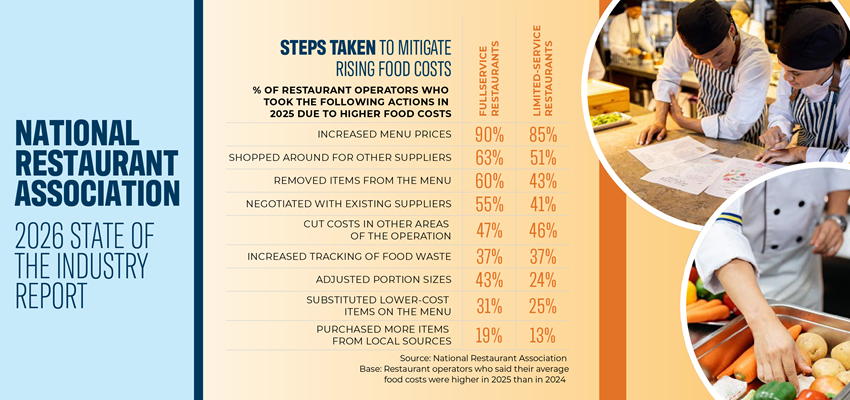
To cope, restaurants leaned heavily on menu price increases and operational adjustments.
Among fullservice restaurant operators, 90% said they’d raised their prices, while 63% sought alternative suppliers and 60% removed items from their menus. Limited-service operators adopted similar strategies, though with less flexibility. About 85% said they’d increased their prices, while 51% sourced new suppliers and 43% reduced menu offerings.
Despite those efforts, many operators said they’re limited in fully offsetting rising costs without risking customer traffic.
“The industry will remain challenged, especially in regard to costs,” he said. “Hopefully food prices will start to moderate this year, but likely will stay solid. As a result, there’ll be a continued need for operators to focus on finding efficiencies where they can. With consumers so stressed about their own economic challenges, restaurateurs are worried that if they pass on any more of their higher costs to customers, it’ll exacerbate the traffic challenges they’re already experiencing. It’s really a damned if you do, damned if you don’t place to be.”
2026 Outlook: Prices continue to drive operating pressures
Forecasts for this year suggest something of a redux of 2025. Commodities analysts at Advanced Economic Solutions said that this year the protein markets will be the primary driver of food price pressure, citing tight supplies, disease risks, and historically low cold-storage inventories. Following is their breakdown of those markets:- Beef supplies are expected to remain especially constrained, with U.S. cattle inventories at multidecade lows. While 2026 may mark the bottom of the cattle cycle, herd expansion is expected to be slow, keeping prices elevated through at least 2027.
- Pork production is also limited by a contracting breeding herd, with any meaningful supply increases unlikely before 2027. The potential for disease also remains a key uncertainty that could further disrupt the market.
- Poultry could offer some potential for growth, with broiler production projected to increase modestly. However, capacity constraints and the ongoing threat of avian flu could limit gains. Turkey markets are expected to remain tight, and egg supplies—still recovering from losses exceeding 144 million birds since 2022—are below balanced levels.
- Dairy markets present a more mixed picture. Milk and cheese supplies are expected to increase, potentially softening prices, but butter markets could tighten if export demand remains strong.
- Grain markets are expected to benefit from record yields. Corn and wheat supplies are projected to remain abundant, keeping prices relatively low and offering some cost relief for producers.
- Soft commodities, such as cocoa, sugar, and coffee, are expected to decline though volatility will remain likely—particularly in coffee markets because of tight global supplies.
Looking ahead, industry stakeholders are closely monitoring upcoming trade negotiations, including the scheduled 2026 review of the United States-Mexico-Canada Agreement (USMCA), which could further influence pricing and supply dynamics.
“Operators are going to need continued clarity regarding the USMCA treaty and what's going to happen with that,” Moutray said. “It’s something that will be top of mind for everyone.”
Download the 2026 State of the Restaurant Industry report

Sign up for our Newsletter
The latest news from the National Restaurant Association, published every other Thursday
By clicking Submit I agree to receive email communications from the National Restaurant Association and agree to our Privacy Policy(Opens in a new window).